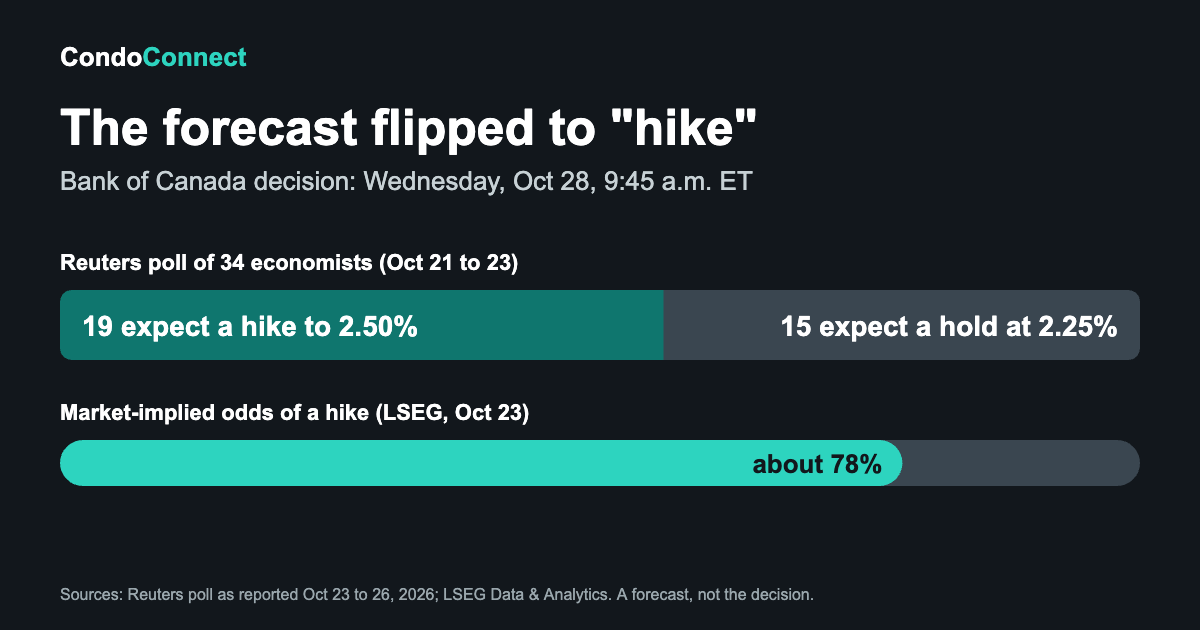
Ten days ago, most economists expected the Bank of Canada to hold rates on October 28. Now a quarter-point hike to 2.50% is the consensus call. If you own a condo you rent out, have a pre-construction unit closing in the next year, or are deciding whether to buy, here are straight answers to the six questions we hear most, before the 9:45 a.m. ET announcement on Wednesday.
Decision watch: The Bank of Canada announces at 9:45 a.m. ET on October 28, 2026. We will update this article with the result and what it means for condo owners shortly after. For the mortgage basics, see our earlier guide, Bank of Canada Oct. 28: What It Means for Condo Mortgages.
Key takeaways
- 19 of 34 economists now expect a hike to 2.50%; markets priced the odds near 78% on October 23.
- A hike raises prime from 4.45% to an expected 4.70%, which flows straight into variable mortgages and HELOCs.
- Pre-construction buyers face the biggest risk: you qualify again at closing, at whatever rates apply then.
- GTA condo apartments averaged $605,257 in September and took 42 days to sell, the slowest of any home type.
- For buyers with a pre-approval and a rate hold, a cautious market means real negotiating room.
1. Why did the forecast flip from hold to hike?
Two things. First, inflation: Statistics Canada reported that consumer prices rose 3.1% in the year to September, pushed up by gasoline as the war in the Middle East kept oil expensive. Second, Governor Tiff Macklem, speaking at the IMF meetings in Bangkok, said high energy prices will raise the Bank’s inflation outlook and that “the risk that inflation broadens and becomes more persistent has gone up.” RBC economists said those comments drove the shift.
The hold camp has a case. The economy lost 68,000 jobs in September, the Bank’s core inflation measures are still under 2%, and the housing market is weak. TD Securities still calls for a hold, and CIBC’s Avery Shenfeld has suggested waiting until December or January. That is why we frame this as likely, not certain.
2. I rent out my condo on a variable mortgage. What does a hike do to my cash flow?
It raises your carrying cost the day your lender moves prime, usually within a day of the announcement. Rent does not move with it: most leases are fixed for the term, and many units are covered by rent increase guidelines. Our rent control guide explains which condos are exempt.
| Variable mortgage balance | Payment at 3.50% | Payment at 3.75% | Extra per year |
|---|---|---|---|
| $400,000 | $2,002 | $2,057 | about $650 |
| $500,000 | $2,503 | $2,571 | about $810 |
| $600,000 | $3,004 | $3,085 | about $970 |
25-year amortization, illustrative discounted variable rate. Add a HELOC used for the down payment and the hit is larger, since most HELOCs float at prime plus a margin.
3. My pre-construction condo closes in the next year. Is it at risk?
This is the group to watch most closely. When your building registers, your lender approves the final mortgage again, using the rates and the stress test in effect then. You qualify at the higher of 5.25% or your contract rate plus 2 points, so every rise in rates trims the mortgage you can get.
The second risk is value. If the unit appraises for less than you agreed to pay years ago, the lender lends on the lower number and you cover the gap in cash. We walk through that in the pre-construction appraisal gap. Also budget for interim occupancy fees, which run until registration.
Tip: If your closing is within about four months, ask your lender for a rate hold now. If it is further out, run your approval at 2.75% so a second hike does not catch you short. If the numbers do not work, an assignment sale before closing is one option; see assignment sales.
4. Should I sell my investment condo before rates go higher?
Look at the market you would be selling into. In September 2026, TRREB counted 1,316 condo apartment sales across the GTA at an average of $605,257, with listings taking 42 days on average, the longest of any home type. Sellers are competing for a smaller pool of buyers.
A sale makes sense when the carrying cost is hurting and the unit is unlikely to cover itself even at today’s rents. Before deciding, check what similar units in your building actually sold for with sold prices or building match, and read selling a condo when inventory is high. Keep in mind the tax side, covered in capital gains on a rental condo.
5. Is a hike actually good news for condo buyers?
For buyers who are ready, it can be. Rate worries keep many buyers waiting, which gives the ones who act more choice and more room on price. TRREB noted that buyers want confidence that inflation will not keep pushing up borrowing costs before they commit.
The payment change on a typical first purchase is modest. On the September average condo price of $605,257, with 10% down, default insurance added and the 30-year amortization available to first-time buyers, a quarter-point hike moves the payment from about $2,522 to $2,601 a month. Our guide to the 30-year amortization for first-time condo buyers explains who qualifies.
6. What happens after Wednesday?
The next decision is December 9, 2026. Oxford Economics sees the rate reaching 2.75% by year-end, and most economists in the Reuters poll expect a second hike by the end of March 2027. If the Bank holds instead, watch the statement for a signal that it is leaning toward a December move. Either way, fixed rates follow bond yields, which have already climbed this year, so do not wait for the Bank to act before locking a rate.
Before 9:45 a.m. Wednesday
- Check whether your mortgage payment is fixed or adjustable, and what prime-plus margin your HELOC uses.
- If you are buying or closing within four months, get a rate hold.
- Re-run your numbers at 2.50% and 2.75% with the condo calculators.
- If you are thinking of selling, get a current value first: what is my condo worth.
Frequently asked questions
Is the Bank of Canada expected to raise rates on October 28, 2026?
Yes, a quarter-point hike to 2.50% is now the most common forecast. 19 of 34 economists in a Reuters poll expect it and markets priced the odds near 78%, though some banks, including TD Securities, still expect a hold.
How does a rate hike affect a rented condo with a variable mortgage?
Your interest cost rises right away. On a $500,000 variable mortgage at about 3.50% over 25 years, a quarter-point hike adds about $68 a month, roughly $810 a year, with no matching increase in rent for most tenants.
Does a rate hike affect my pre-construction condo closing?
It can. Your lender approves you again near closing, using the rates and stress test in place at that time. Higher rates can shrink the mortgage you qualify for, which matters most if the unit also appraises below the price you paid.
Will Toronto condo prices drop if rates go up?
Nobody can promise a direction. Condo apartments were already the slowest GTA segment in September 2026, averaging $605,257 and 42 days on market, so higher rates tend to keep buyers cautious and give them more room to negotiate.
This article is general information as of October 27, 2026, not legal, tax, mortgage or financial advice. Payment figures are estimates. Rules and numbers change, so confirm the details for your situation with a licensed professional. Sources: Bank of Canada, Statistics Canada, TRREB Market Watch (September 2026), Reuters poll (October 21 to 23, 2026), LSEG.