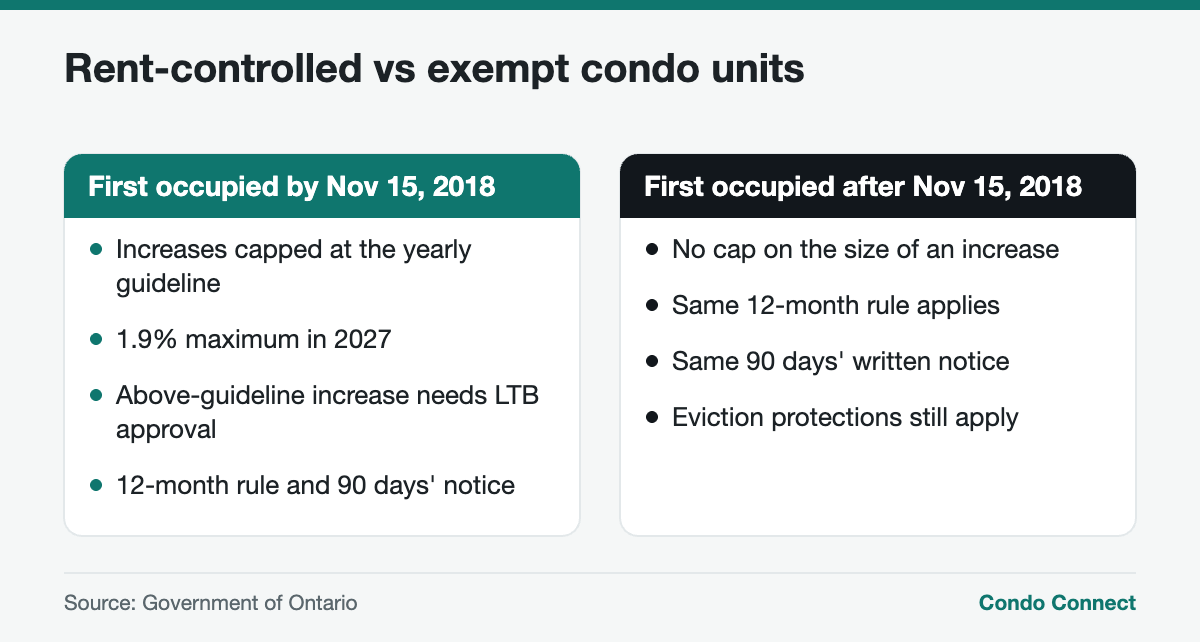
An Ontario condo is rent controlled if the unit was first occupied for residential purposes on or before November 15, 2018. If it was first lived in after that date, it is exempt from the annual rent increase guideline, so the landlord can raise the rent by any amount, though only once every 12 months and with 90 days’ written notice. The guideline for controlled units is 2.1% in 2026 and 1.9% in 2027.
Key takeaways
- The test is when the unit was first occupied for residential purposes, not when you signed your lease or when the owner bought it.
- Most units in buildings completed after late 2018 are exempt from the guideline.
- Exempt units still follow the 12-month rule, the 90-day notice rule and eviction protections.
- When a tenant leaves, the landlord can set any rent for the next tenant, controlled or not.
- With condo rents down about 2% year over year, the exemption matters less this year than it did in 2022 and 2023.
What is the November 15, 2018 rent control exemption?
In late 2018 the Ontario government exempted newly occupied rental units from the rent increase guideline to encourage new rental supply. According to the province’s residential rent increases page, new buildings, additions to existing buildings and most new basement apartments that are occupied for the first time for residential purposes after November 15, 2018 are exempt.
For the Toronto condo market that is a big share of the rental stock. Tens of thousands of condo units have been completed since 2018, and a large proportion are owned by investors and rented out.
How to tell whether your condo is rent controlled
The question is when the unit itself was first occupied, by anyone, as a home. A few practical ways to find out:
- Ask the landlord in writing when the unit was first occupied. A landlord relying on the exemption should be able to say.
- Find when the building was completed. Occupancy of new condos usually starts before registration, during the interim occupancy period. If the building’s first residents moved in during 2019 or later, the units are very likely exempt.
- Watch for edge cases. A building completed in phases may have some units occupied before the cut-off and others after it. A unit that was an owner’s home in 2017 and is rented for the first time in 2026 is still rent controlled, because it was first occupied before the date.
If you and your landlord disagree, the Landlord and Tenant Board decides. Keep any emails or documents that show the occupancy date.
How much can rent go up on a controlled condo?
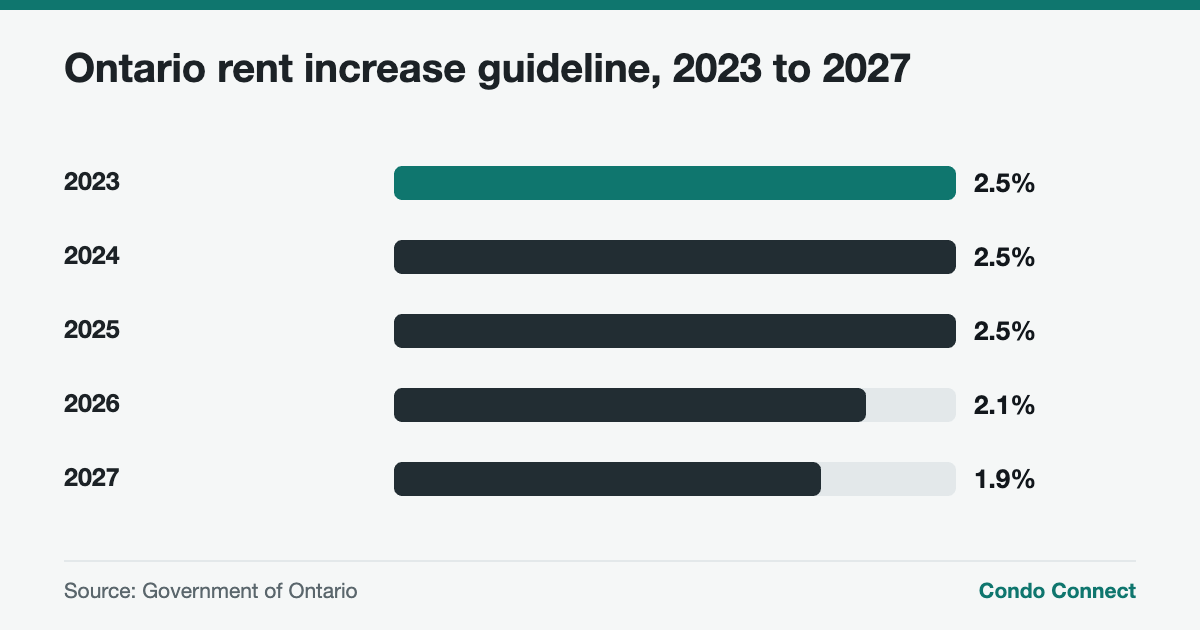
For a controlled unit, the maximum increase without the Board’s approval is the annual guideline: 2.1% for increases taking effect in 2026 and 1.9% in 2027, down from 2.5% in each of 2023, 2024 and 2025. On a $2,400 monthly rent, a 2.1% increase gives $2,450.40, and a 1.9% increase the following year takes it to about $2,496.96.
A landlord can apply to the Landlord and Tenant Board for an above-guideline increase in some cases, for example after major capital work, but that requires an application and a hearing. A tenant and landlord can also agree to an increase in exchange for something specific, such as a parking space, under rules set by the province.
What rules still apply to exempt condo units?
Exempt does not mean anything goes. For an exempt unit:
- The rent can only be increased once every 12 months, counting from the start of the tenancy or the last increase.
- The landlord must give at least 90 days’ written notice on the proper Landlord and Tenant Board form (Form N1).
- The landlord still cannot end the tenancy without a legal reason and the Board’s process.
- The landlord cannot raise rent mid-lease beyond what the lease allows.
What changes is only the size of the increase. A large increase on an exempt unit is legal if the timing and notice rules are followed, and a tenant who cannot pay it can choose to give notice and leave.
What this means for condo investors in 2026
For investors, the exemption is a long-term protection against falling behind the market. It is less useful in a market where rents are falling. TRREB’s Q2 2026 rental report showed the average GTA one-bedroom condo rent at $2,273, down 2.3% year over year, and two-bedrooms at $3,013, down 1.7%. In that kind of market, the practical ceiling on increases is what tenants will pay, not the law.
Two things are worth weighing when you buy:
- A post-2018 unit lets you move rent to market over time, which helps if your carrying costs rise at mortgage renewal.
- A pre-2018 unit with a long-term tenant may be paying well below market, and you cannot raise it by more than the guideline while that tenancy continues. Check the current rent, the start date and the last increase before you make an offer.
If you are buying a brand-new condo to rent out, it will be exempt. Our guide to buying an unsold new condo from a developer covers what to check in a newly registered building, and our look at whether now is a good time to buy a Toronto condo sets out the current market.
Tip: Landlords of controlled units sometimes skip the annual increase to keep a good tenant happy, then find years later that the rent sits far below market with no legal way to catch up quickly. A small increase on the right date each year is usually easier for both sides. Put the next eligible increase date, and the date 90 days before it, in your calendar the day the lease starts.
Rent control and new tenants
Ontario does not control rent between tenancies. When a tenant moves out voluntarily, the landlord can set the rent for the next tenant at whatever the market will pay, whether the unit is controlled or exempt. The guideline only limits increases during a tenancy.
That is why a long tenancy in a controlled unit can drift well below market rent, and why some landlords look for ways to end those tenancies. Ending a tenancy requires a legal reason, such as the landlord’s own use, and the Board’s process, with compensation required in some cases.
Frequently asked questions
Are all new condos in Ontario exempt from rent control?
Units first occupied for residential purposes after November 15, 2018 are exempt from the rent increase guideline, which covers condos completed since then. The exemption is about the size of increases only. The 12-month rule, 90-day notice requirement and eviction protections under the Residential Tenancies Act still apply to these units.
What is the 2027 rent increase guideline in Ontario?
The guideline for 2027 is 1.9%, down from 2.1% in 2026, according to the Government of Ontario. It applies to increases taking effect between January 1 and December 31, 2027, and only to units first occupied on or before November 15, 2018. Landlords must still give 90 days’ written notice.
Can my landlord raise my rent by 10% in Ontario?
Only if your unit is exempt from the guideline, or the Landlord and Tenant Board approves an above-guideline increase for a controlled unit. Even for an exempt unit, the increase can happen only once every 12 months with at least 90 days’ written notice on the proper form. If those steps are missed, the increase is not valid.
Does rent control apply to a condo I rent from an individual owner?
Yes. The Residential Tenancies Act applies to most residential tenancies, including condos rented from individual investors, not just purpose-built apartment buildings. Whether the guideline limits increases depends on the unit’s first occupancy date, not on the type of landlord. Some situations, such as sharing a kitchen with the owner, fall outside the Act.
Buying a condo to rent out?
Browse Toronto condos for sale, check carrying costs with our investor and buyer calculators, or contact our team for rent comparables in the buildings you are considering.
This article is general information as of October 2026, not legal, tax, mortgage or financial advice. Rules and numbers change, so confirm the details for your situation with a licensed professional.