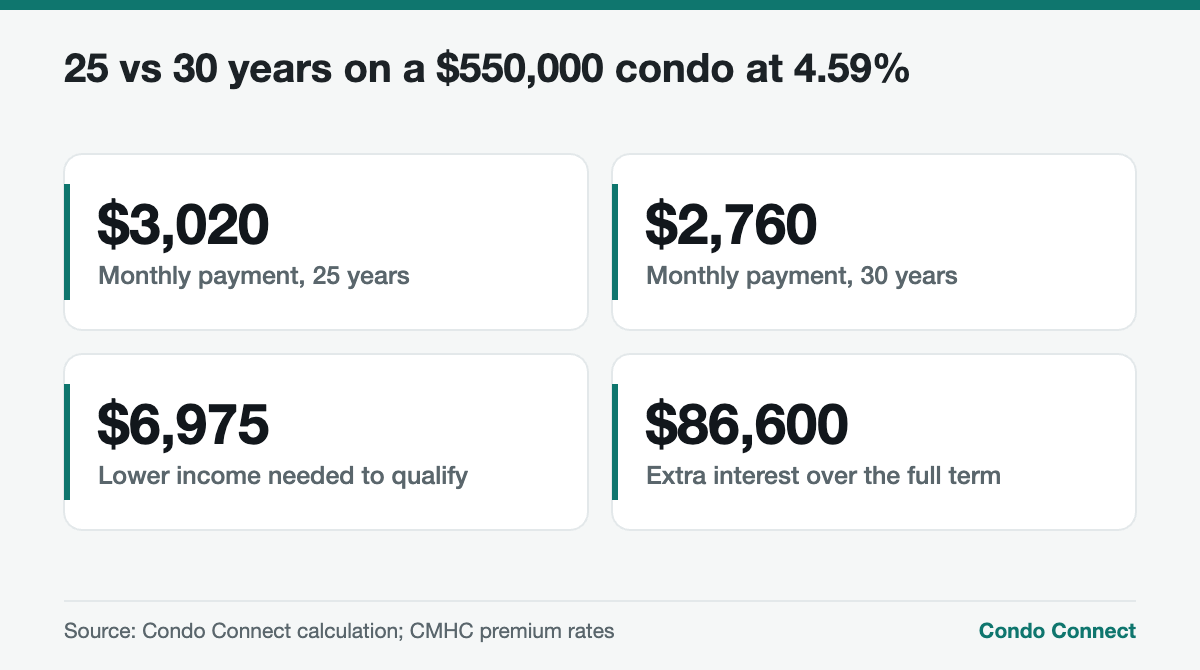
Yes, a first-time buyer can get a 30-year amortization on an insured condo mortgage, and so can anyone buying a newly built, never-occupied unit. On a $550,000 condo with the minimum down payment, stretching from 25 to 30 years lowers the monthly payment by about $260 at a 4.59% rate. The trade-off is a slightly higher insurance premium (4.20% instead of 4.00%), slower equity build-up and about $86,600 more interest if the rate never changed.
Key takeaways
- Insured 30-year amortizations have been available since December 15, 2024 to first-time buyers and buyers of new builds.
- CMHC offers it through Home Start, with premiums 0.20 percentage points higher than the 25-year rates.
- On a $550,000 condo with $30,000 down, the payment drops from about $3,020 to about $2,760 a month.
- The income needed to qualify falls by roughly $7,000 a year in our example.
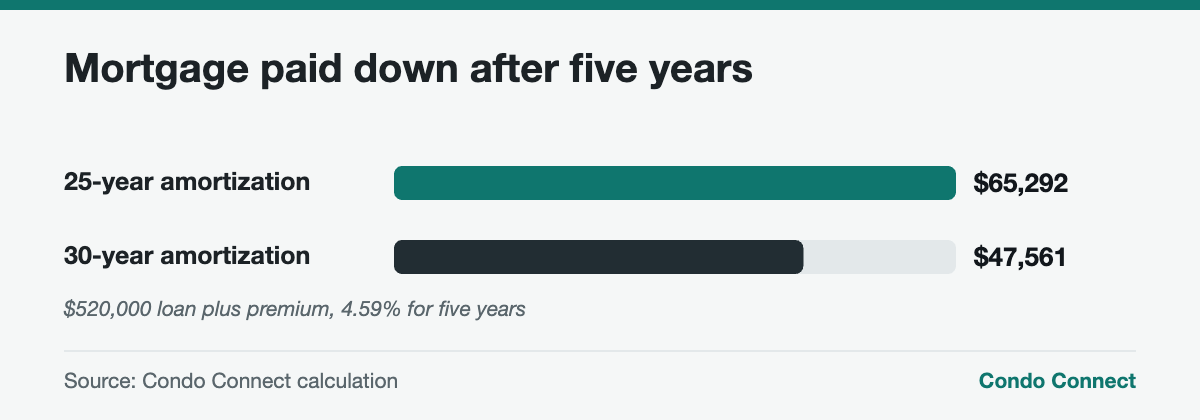
- After five years you would have paid off about $17,700 less principal.
Who qualifies for a 30-year insured mortgage?
CMHC’s Home Start program allows a 30-year amortization on an insured mortgage if at least one of these applies:
- You are a first-time buyer. That means you have not owned and lived in a home in the current year or the previous four years, the same test used for the FHSA.
- You are buying a newly built home that has never been occupied, which includes a new condo bought from a developer or a pre-construction unit at final closing.
The price must be below $1.5 million, the maximum for an insured mortgage, and the unit must be your home. The usual insured-mortgage limits apply: gross debt service no higher than 39% of income, total debt service no higher than 44%, and a minimum credit score of 600 for at least one borrower.
Note that this first-time buyer test is looser than the one for the land transfer tax refund, which requires that you have never owned a home anywhere. You can qualify for the 30-year option but not the tax refund.
The numbers on a $550,000 condo
The minimum down payment on $550,000 is 5% of the first $500,000 plus 10% of the remaining $50,000, or $30,000. That leaves a $520,000 loan, a loan-to-value ratio of about 94.5%, which falls in the 90.01% to 95% premium band on CMHC’s premium schedule.
| Item | 25-year amortization | 30-year amortization |
|---|---|---|
| Premium rate | 4.00% | 4.20% |
| Premium added to the loan | $20,800 | $21,840 |
| Ontario sales tax on premium (paid in cash) | $1,664 | $1,747 |
| Total mortgage | $540,800 | $541,840 |
| Monthly payment at 4.34% | $2,945 | $2,682 |
| Monthly payment at 4.59% | $3,020 | $2,760 |
| Principal repaid after 5 years at 4.59% | $65,292 | $47,561 |
The 4.34% and 4.59% rates reflect the range of discounted insured 5-year fixed rates in mid-October 2026. Payments assume semi-annual compounding, the Canadian standard for fixed-rate mortgages.
How much income do you need for a condo mortgage?
Lenders qualify you at the higher of your contract rate plus 2% or 5.25%. At a 4.59% contract rate, that is 6.59%. They then add property tax and part of your condo fee to the qualifying payment and test it against your income.
For this example we used Toronto’s 2026 residential tax rate of 0.767311% applied to the price (about $352 a month) and half of an assumed $500 monthly condo fee. At the 39% gross debt service limit, the income needed is about $130,900 with a 25-year amortization and about $123,900 with 30 years. That is a difference of about $6,975 in household income, before counting heating costs or other debts, which raise the real figure.
For many first-time buyers in Toronto, that gap is the difference between qualifying for the unit they want and settling for a smaller one. If your building’s fees are higher, the effect is bigger; see our look at Toronto condo maintenance fees.
The real cost of a longer amortization
If the rate stayed at 4.59% for the whole life of the mortgage, total interest would be about $365,300 over 25 years and about $451,900 over 30 years: roughly $86,600 more. Rates will not stay the same, but the direction is reliable. A longer amortization means you pay interest on a larger balance for longer.
The early years matter most for condo owners, many of whom sell within five to ten years to move up. After five years, the 30-year borrower has repaid about $17,700 less principal. That is less equity to carry into the next home.
Tip: Take the 30-year amortization to qualify and keep your monthly budget safe, then use prepayment privileges to shorten it. Most lenders allow annual lump sums and payment increases. Raising the payment on our example from $2,760 to the 25-year level of $3,020 once your income allows gets you back on a 25-year track without refinancing.
When a 30-year amortization makes sense for a condo
- You need it to qualify, and the unit is one you will happily live in for years.
- You want a lower required payment as a cushion against a job change or rate increase.
- You plan to prepay when your income rises.
- You are buying a new condo and want breathing room while closing costs and furnishing hit at once.
It makes less sense if you can comfortably afford the 25-year payment, or if the lower payment tempts you into a pricier unit with high fees. Remember that closing costs, including land transfer tax on a Toronto condo, still need to be paid in cash on top of the down payment.
Using registered savings for the down payment
First-time buyers can combine the 30-year option with the FHSA (up to $8,000 a year and $40,000 lifetime) and the RRSP Home Buyers’ Plan (up to $60,000 per person). A couple using both could assemble the $30,000 minimum down payment in our example, plus closing costs, largely from tax-advantaged accounts.
Frequently asked questions
Can you get a 30-year mortgage on a resale condo?
Yes, if you are a first-time buyer. The insured 30-year option covers resale homes for first-time buyers and new builds for any buyer. A repeat buyer purchasing a resale condo with less than 20% down is limited to 25 years. With 20% or more down, many lenders offer 30-year uninsured mortgages, subject to the stress test.
How much more is CMHC insurance for 30 years?
The premium is 0.20 percentage points higher at each loan-to-value band. With 5% to 10% down, it is 4.20% instead of 4.00%. On a $520,000 loan, that is $21,840 instead of $20,800, an extra $1,040 added to the mortgage. Ontario charges 8% sales tax on the premium, which must be paid in cash at closing.
Does a 30-year amortization help with the stress test?
Yes. The stress test applies the qualifying rate to your payment, and a longer amortization lowers that payment. In our $550,000 example, it reduced the income needed by about $6,975 a year. It does not change the qualifying rate itself, which is the higher of your contract rate plus 2% or 5.25%.
Who counts as a first-time buyer for the 30-year amortization?
Someone who has not owned and lived in a home in the current year or any of the previous four calendar years. This matches the FHSA definition. It is less strict than Ontario’s land transfer tax refund rules, which require that you have never owned a home anywhere in the world.
Run your own numbers
Try different prices and rates with our mortgage calculators, check what the next rate decision could mean in our Bank of Canada guide for condo buyers, and browse Toronto condos for sale in your approved range.
This article is general information as of October 2026, not legal, tax, mortgage or financial advice. Rules and numbers change, so confirm the details for your situation with a licensed professional.