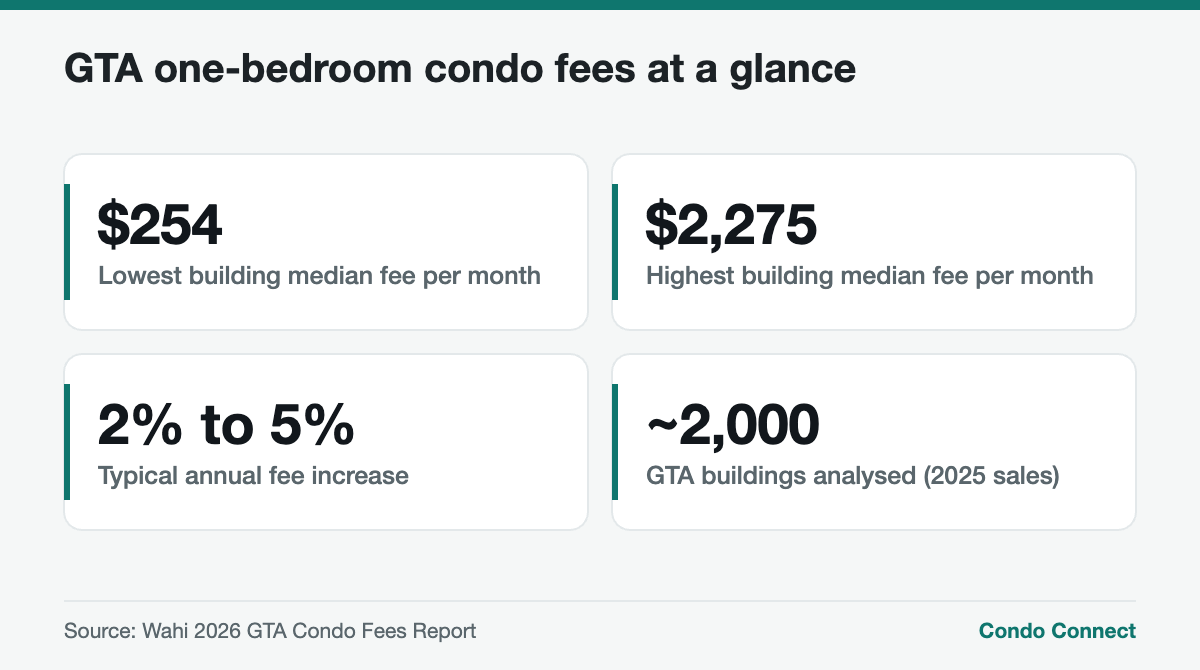
There is no single “normal” condo fee in Toronto, because fees depend on what a building includes, how old it is and how well its reserve fund is funded. Wahi’s 2026 analysis of about 2,000 GTA buildings found median one-bedroom fees ranging from about $254 to $2,275 a month. The useful way to judge a fee is to compare it per square foot with similar buildings nearby, then check what it covers and whether the reserve fund is healthy.
Key takeaways
- Fees pay for running the building and for a legally required reserve fund for major repairs.
- Compare buildings by fee per square foot, adjusted for which utilities are included.
- Typical annual increases are 2% to 5%, but a new reserve fund study can trigger bigger jumps.
- Very low fees in an older building can mean an underfunded reserve and a special assessment later.
- Lenders count part of your fee in your debt ratios, so fees affect how much you can borrow.
What do condo maintenance fees cover?
Your monthly fee is your share of the condo corporation’s budget. It usually breaks down into two parts.
- Operating costs: building insurance, property management, cleaning, security or concierge, elevator and HVAC contracts, landscaping, snow removal, amenities and common-area utilities.
- Reserve fund contribution: money set aside for major repairs and replacements such as the roof, windows, garage membrane, elevators and mechanical systems.
Many buildings also include some unit utilities. Older buildings often include heat, hydro and water in the fee; newer buildings usually have separate meters for each unit. That single difference can make an older building’s fee look much higher than it really is, so compare total monthly costs, not fees alone. Our page on condo maintenance fees lists what to ask about inclusions.
Why are Toronto condo fees so high in some buildings?
The Wahi report, based on 2025 sales and published in July 2026, found that all but two of the lowest-fee buildings were completed within the last eight years, while the most expensive were typically much older, with seven completed in 1991 or earlier. The main drivers are:
- Age. Older buildings need more repairs and often fund big projects such as window and balcony replacements.
- Included utilities. Heat and hydro for every unit come out of the common budget.
- Staffing and amenities. A 24-hour concierge, pool and large party room cost far more to run than a gym and a parcel room.
- Building size. Small buildings have fewer owners to share fixed costs.
- Luxury service. Wahi found the highest-fee building’s median was more than $1,000 above the next one.
How to compare condo fees per square foot
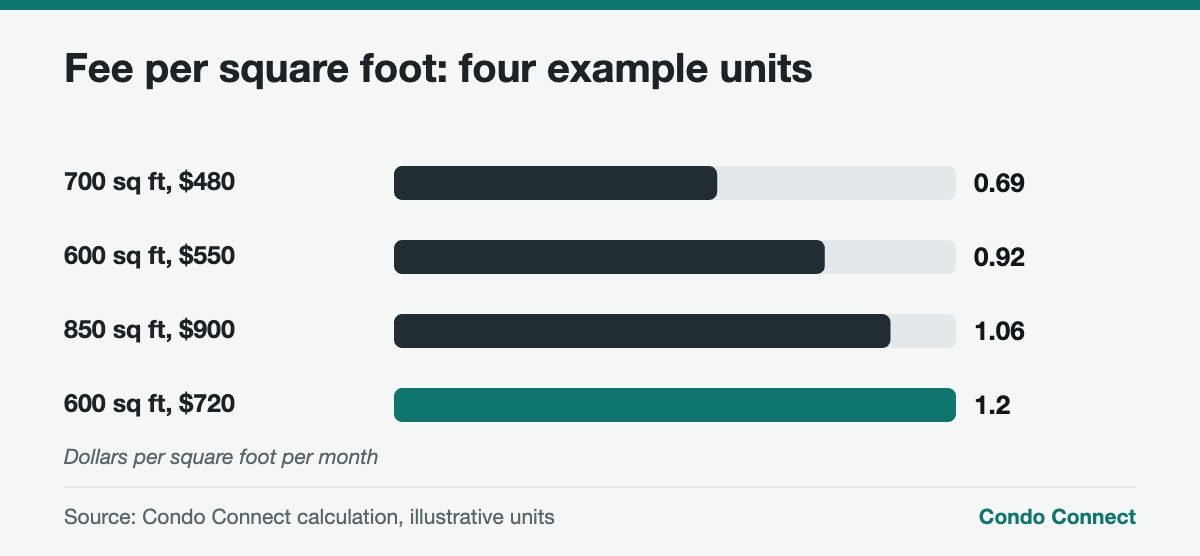
Divide the monthly fee by the unit’s square footage. Then compare buildings of similar age with similar inclusions. Here are four illustrative units.
| Unit | Monthly fee | Fee per sq ft | Annual cost |
|---|---|---|---|
| 700 sq ft, newer building, utilities metered | $480 | $0.69 | $5,760 |
| 600 sq ft, newer building, utilities metered | $550 | $0.92 | $6,600 |
| 850 sq ft, 1990s building, heat and hydro included | $900 | $1.06 | $10,800 |
| 600 sq ft, full-service building, concierge and pool | $720 | $1.20 | $8,640 |
The 1990s unit looks the most expensive in dollars, but once you subtract the hydro and heat you would otherwise pay yourself, it may be in line with the others. The full-service unit is the one to question: is the concierge and pool worth $0.28 to $0.51 per square foot more to you?
How much do condo fees go up each year?
Wahi notes that annual increases typically fall in the 2% to 5% range. On a $550 fee, that is the difference between about $607 and about $702 a month after five years.
Bigger jumps usually follow a reserve fund study. Under Ontario rules summarized by the Condo Authority of Ontario, a new corporation must complete a comprehensive study within a year of registration, then updated studies at least every three years. When a study shows the fund is short, the board adopts a funding plan and owners receive a notice of future funding. The plan often means fees rise faster for several years.
When low condo fees are a red flag
A low fee in a new building is normal: little needs repairing yet. A low fee in a 25-year-old building deserves questions. It can mean the board has kept fees down by under-contributing to the reserve fund, which leaves a gap that is eventually filled by a special assessment or steep increases.
Before the first study, Ontario requires a corporation to contribute at least the greater of 10% of its operating budget or the amount reasonably expected to fund future major repairs, according to the CAO’s guide to reserve funds. Some developers set first-year budgets low to make units easier to sell, so check the reserve fund study and funding plan in a newer building too.
Tip: In the status certificate, find the reserve fund balance and the planned contributions in the most recent notice of future funding. If the plan shows contributions rising 8% or 10% a year for the next several years, your fee will likely follow. Our status certificate guide shows where these figures appear.
How condo fees affect your mortgage approval
Lenders include part of your condo fee in your housing costs when they calculate your gross debt service ratio, and insured mortgages cap that ratio at 39% of income. Many lenders count half the fee, so a $550 fee adds about $275 a month to your qualifying costs.
Fees also compete with your mortgage for the same budget. At a 4.59% rate over 25 years, an extra $100 a month in fees costs about the same as carrying roughly $17,900 more mortgage, and an extra $200 is about $35,800. When comparing two similar units, a lower price with a much higher fee is not always the better deal. Our guide to condo mortgages and the October rate decision has current payment figures.
Questions to ask before you buy
- Which utilities are included, and are units individually metered?
- When was the last reserve fund study, and what does the funding plan require?
- Have fees risen more than 5% in any of the last three years?
- Are any special assessments planned or under discussion?
- Are major projects (windows, garage, elevators) scheduled in the next five years?
- Does the parking spot or locker carry its own separate fee?
Frequently asked questions
What is a normal condo fee per square foot in Toronto?
It varies widely with building age, inclusions and services, so there is no official benchmark. Use fee per square foot to compare similar buildings in the same area, after adjusting for utilities included in the fee. A figure well above nearby buildings needs an explanation, and a figure well below them in an older building deserves a look at the reserve fund.
Can condo fees go down?
Occasionally, for example after a major project is paid off or a better service contract is signed, but it is uncommon. Costs such as insurance, labour and repairs tend to rise, and reserve fund studies often require higher contributions over time. Plan your budget assuming fees will rise each year.
Are condo fees tax deductible in Ontario?
Not for a home you live in. If you rent the condo out, the condo fees for the rental period are generally deductible against rental income on your tax return. If you rent out part of the year or use part of the unit personally, only the rental portion is deductible. Ask an accountant about your situation.
Do condo fees include property taxes?
No. Each unit owner pays property tax directly to the municipality, based on the unit’s assessed value. In Toronto, the 2026 total residential rate is about 0.77% of assessed value. Condo fees cover the corporation’s operating costs and reserve fund contribution, and sometimes some unit utilities, but never your property tax.
Compare fees before you fall for a unit
Browse Toronto condos for sale with fees shown on each listing, or test how a fee changes your budget with our buyer calculators.
This article is general information as of October 2026, not legal, tax, mortgage or financial advice. Rules and numbers change, so confirm the details for your situation with a licensed professional.