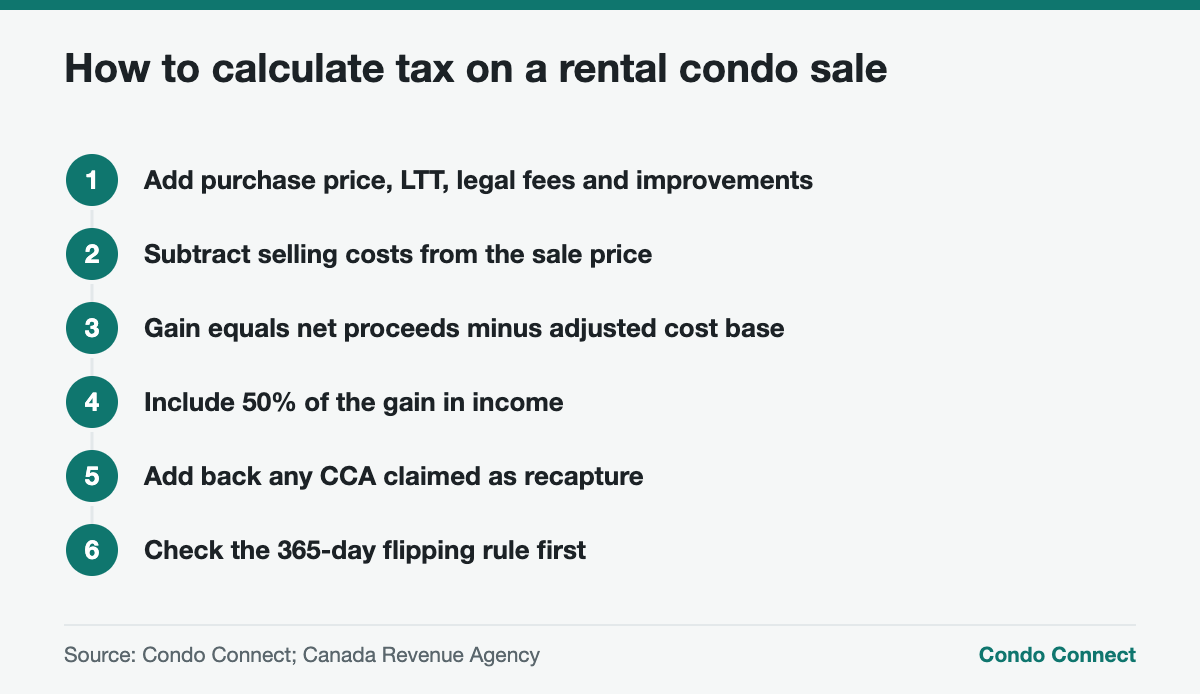
When you sell a rental condo in Ontario, you pay tax on half of the capital gain: the sale price minus selling costs, minus your adjusted cost base. The inclusion rate is still one-half, because the planned increase to two-thirds was cancelled in March 2025. If you claimed depreciation (capital cost allowance) on the unit, that amount is added back to your income in full, and if you owned the condo for less than 365 days, the whole gain may be taxed as business income.
Key takeaways
- Your adjusted cost base includes the purchase price, land transfer tax, legal fees and capital improvements.
- Only 50% of a capital gain is taxable, at your marginal tax rate.
- Capital cost allowance claimed in past years is recaptured as fully taxable income on sale.
- Selling within 365 days usually triggers the flipping rule: full taxation and no loss deduction.
- A capital loss can offset capital gains in other years, which matters for units bought near the 2022 peak.
How capital gains tax works on an investment condo
A rental condo is capital property, so when you sell it at a profit the gain is a capital gain, unless you are in the business of buying and selling real estate. Half of the gain, the taxable capital gain, is added to your income for the year of sale and taxed at your marginal rate.
The federal government had proposed raising the inclusion rate to two-thirds on gains above $250,000. That proposal was cancelled on March 21, 2025, so the rate remains one-half for individuals.
What goes into your adjusted cost base
The adjusted cost base, or ACB, is everything you paid to acquire the condo and improve it. Common items:
- The purchase price, including any parking or locker units bought with it.
- Land transfer tax; on a Toronto condo that means both the Ontario and municipal tax, as shown in our land transfer tax examples.
- Legal fees and title insurance on purchase.
- Capital improvements, such as a full kitchen renovation or new flooring throughout, as opposed to routine repairs.
- For a pre-construction unit, any assignment premium you paid and certain closing adjustments; ask your accountant which ones qualify.
Routine repairs and maintenance, condo fees and property tax are deducted from rental income each year as you go. They do not go into the ACB.
A worked example
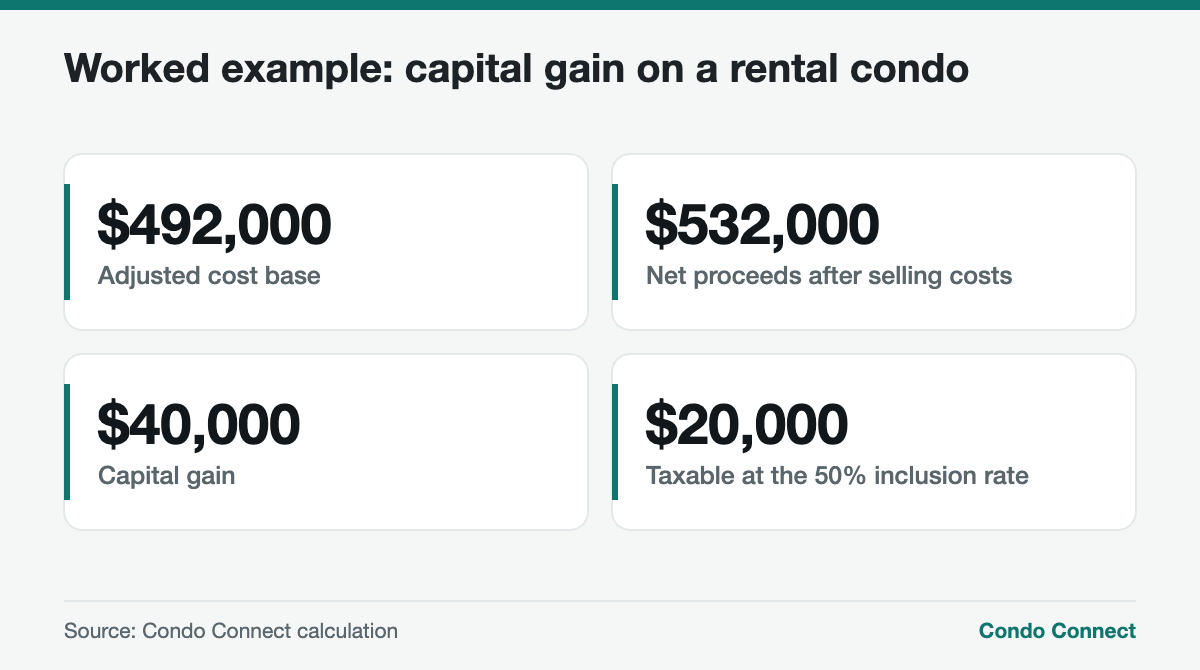
You bought a rental condo for $480,000 and paid $12,000 in land transfer tax and legal fees. You sell it for $560,000 and pay 5% in commission and legal fees on the sale, which is $28,000.
| Step | Amount |
|---|---|
| Sale price | $560,000 |
| Less selling costs (5%) | -$28,000 |
| Net proceeds | $532,000 |
| Less adjusted cost base ($480,000 + $12,000) | -$492,000 |
| Capital gain | $40,000 |
| Taxable capital gain (50%) | $20,000 |
The tax depends on your other income. At Ontario’s top combined marginal rate of about 53.5%, $20,000 of taxable gain would cost about $10,700 in tax. At lower incomes, the bill is smaller. Closing in January rather than December can sometimes move the gain into a lower-income year, which is worth discussing with an accountant.
Capital cost allowance recapture
Some landlords claim capital cost allowance (CCA), a tax deduction for depreciation on the building portion of the condo, to reduce rental income. It can be useful while you own the unit, but it comes back when you sell. If the sale price of the building portion exceeds its depreciated value, the CCA you claimed is “recaptured” and taxed as ordinary income in full, not at the 50% inclusion rate.
As an illustration, if you had claimed $20,000 of CCA over the years, that $20,000 is added to your income in the year of sale on top of the taxable capital gain. Many condo landlords skip CCA for this reason, particularly when they expect to sell within a few years.
The 365-day flipping rule
Since 2023, a gain on residential property owned for less than 365 consecutive days is generally treated as business income, fully taxable, unless the sale was caused by a life event. The CRA’s housing tax tips summarize the rule, and tax firms note that losses on such flips are denied. Life events include death, marital breakdown, serious illness or disability, a new family member, eligible work relocation, involuntary job loss and insolvency.
The rule also covers rights to buy housing, which includes pre-construction contracts; our guide to selling a condo assignment covers that side. Owning longer than 365 days does not guarantee capital gains treatment if you bought with the intention to resell.
Tip: Start a simple folder the day you buy a rental condo: the statement of adjustments, land transfer tax receipt, legal invoices, and every invoice for improvements. Years later, these records decide your adjusted cost base. Without them, you may end up paying tax on a gain that was really money you spent on the unit.
Selling a rental condo at a loss
Many investors who bought near the 2022 peak are selling for less. A capital loss (net proceeds below your ACB) is not deductible against your regular income, but it can offset capital gains: applied against gains in the same year, carried back up to three years, or carried forward indefinitely. Report it properly even if you have no gains now; it may be valuable later.
If you are selling into a soft market, our playbook for selling a condo when inventory is high covers pricing and holding costs.
If you also lived in the condo
If the condo was your home for part of the time you owned it, the principal residence exemption may cover part of the gain. Under the CRA’s principal residence rules, the exempt portion uses a “one plus the number of years designated” formula over the years owned, and only one property per family unit can be designated for each year. Every sale must be reported on Schedule 3 of your return, even if it is fully exempt.
Moving out and renting the unit can also create a deemed sale at fair market value on the date the use changes. An election may let you defer that in some cases. This is a common source of surprise bills, so get advice before you convert a former home into a rental.
Frequently asked questions
How much tax do I pay when I sell a rental condo in Ontario?
Half of your capital gain is added to your income and taxed at your marginal rate. In our example, a $40,000 gain added $20,000 to income, which at the top Ontario rate of about 53.5% costs about $10,700. Any CCA you claimed is taxed in full on top. The exact amount depends on your total income that year.
Is the capital gains inclusion rate going up in 2026?
No. The proposal to raise the inclusion rate to two-thirds on gains above $250,000 was cancelled on March 21, 2025. For individuals the inclusion rate remains one-half, so 50% of a capital gain on a rental condo is taxable. Check for changes in future federal budgets before a large sale.
Can I avoid capital gains tax on a rental condo?
Not legally, if it was always a rental. You can reduce the gain by including every allowable cost in your adjusted cost base and timing the sale in a lower-income year, and you can offset it with capital losses. The principal residence exemption only applies to years when the unit was your home.
Do I pay HST when I sell a used rental condo?
Generally not. The sale of a used residential condo by an individual who is not a builder is usually exempt from HST. Exceptions can arise if you substantially renovated the unit or are considered a builder. A pre-construction assignment is different: since May 2022, assignment sales of new homes are subject to HST.
Thinking about selling your rental?
Start with a condo value estimate to estimate your gain, then talk to our selling team about timing and pricing. Bring your accountant in before you list.
This article is general information as of October 2026, not legal, tax, mortgage or financial advice. Rules and numbers change, so confirm the details for your situation with a licensed professional.