
In Toronto you can only run a short-term rental in your own principal residence, so an investor condo you do not live in cannot legally be listed on Airbnb or similar platforms for stays under 28 days. If the condo is your home, you must register with the City ($390 in 2026), collect the 6% Municipal Accommodation Tax and keep whole-unit rentals to 180 nights a year. Your condo corporation can also ban short-term rentals entirely, and its rules apply on top of the City’s.
Key takeaways
- Toronto permits short-term rentals only in the operator’s principal residence, with one registration per unit.
- Renting the entire unit is capped at 180 nights a year; renting a room while you live there has no cap.
- Many Toronto condo declarations and rules prohibit short-term rentals regardless of City registration.
- The CRA denies all expenses on short-term rental income for any period the rental breaks local rules.
- Investor condos are generally limited to rentals of 28 days or longer.
What counts as a short-term rental in Toronto?
The City defines a short-term rental as renting all or part of a home for less than 28 consecutive days. Stays of 28 days or more are treated as ordinary rentals, which in a condo usually means a lease governed by the Residential Tenancies Act and your condo’s leasing rules.
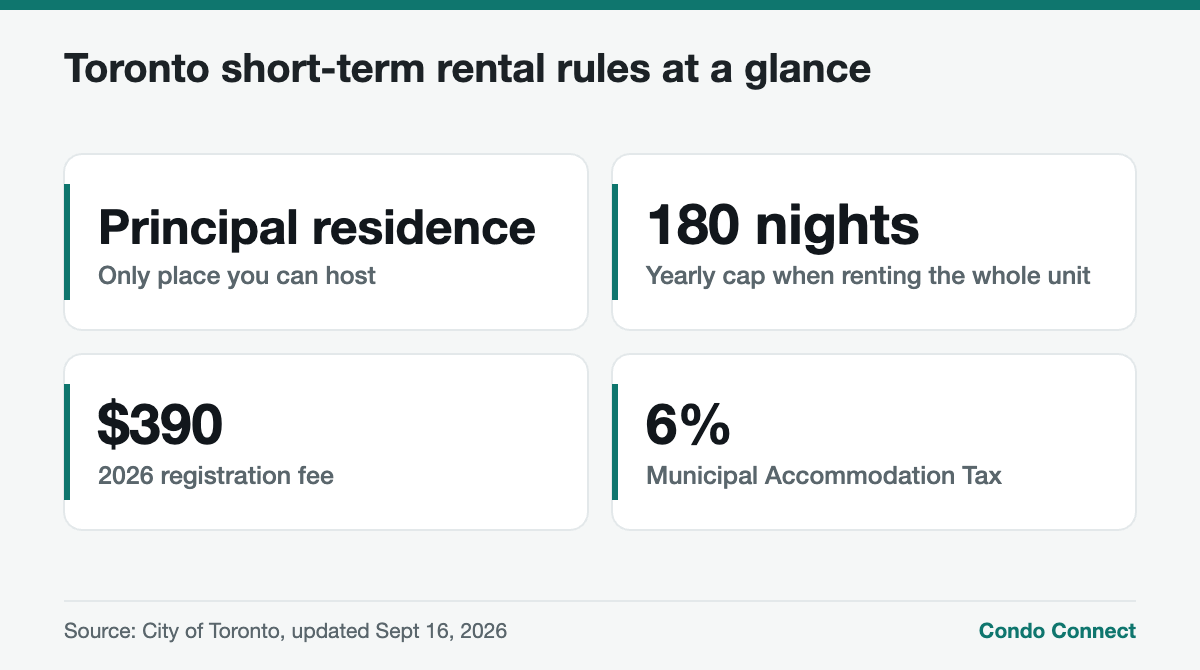
According to the City of Toronto’s rules for operators, updated in September 2026, the key requirements are:
- The unit must be your principal residence, meaning where you live, pay bills and receive mail.
- You must register with the City, and each unit can have only one registration.
- The 2026 registration fee is $390.
- You must collect the 6% Municipal Accommodation Tax on stays.
- Renting your entire home is capped at 180 nights a year. Renting a room while you are living there has no nightly cap.
Can my condo ban Airbnb?
Yes. A condo corporation’s declaration, by-laws and rules can restrict or prohibit short-term rentals, and many Toronto buildings do. Common approaches include a minimum lease term, a ban on any transient or hotel-style use, or a requirement to register every tenant and guest with management.
City registration does not override these rules. The Condo Authority of Ontario makes the same point in its guidance on pet rules: owners and occupants must comply with both municipal by-laws and the condo’s governing documents, so where they differ, the stricter one effectively applies. The same principle holds for short-term rentals. Boards are also obliged to enforce their documents, and owners who breach them can face legal action and be ordered to pay the corporation’s costs.
Before you buy a condo with any short-term rental plans, read the declaration and rules in the status certificate package. Our status certificate guide shows where leasing restrictions usually appear.
Short-term rentals and investor condos
Because hosting is limited to your principal residence, an investment condo you do not live in cannot be a legal short-term rental in Toronto. That leaves two legal options for an investor:
- A standard long-term lease, under the Residential Tenancies Act. Units first occupied after November 15, 2018 are exempt from the rent increase guideline; see our explainer on condo rent control.
- Medium-term furnished rentals of 28 days or more, for example to relocating workers or students, where the condo’s rules allow them.
For owner-occupiers, the 180-night cap still allows meaningful income. Renting the whole unit for 180 nights at an illustrative $150 a night would gross $27,000 before platform fees, cleaning and tax, with $1,620 of Municipal Accommodation Tax collected on top at 6%.
Investors running medium-term furnished rentals should also watch for gaps between guests. Toronto’s Vacant Home Tax is 3% of the unit’s assessed value for homes left unoccupied for more than six months in a year, and every owner must file a declaration by April 30. A furnished unit that sits empty through a slow winter can cross that line faster than expected.
The tax rule that makes illegal hosting expensive
For tax years after 2023, the CRA denies all expenses related to earning short-term rental income for any period in which the rental does not comply with provincial or municipal rules, such as operating without a required registration or where short-term rentals are not permitted. Rental income is reported on Form T776.
In practice, an unregistered or non-compliant host pays tax on gross income with no deductions for mortgage interest, condo fees, property tax, cleaning or platform fees. On $27,000 of gross income, that can turn a modest profit into a significant tax bill.
Short-term accommodation can also be subject to GST/HST, and hosts whose taxable revenue passes the small supplier threshold may need to register. Confirm your position with an accountant before your first booking.
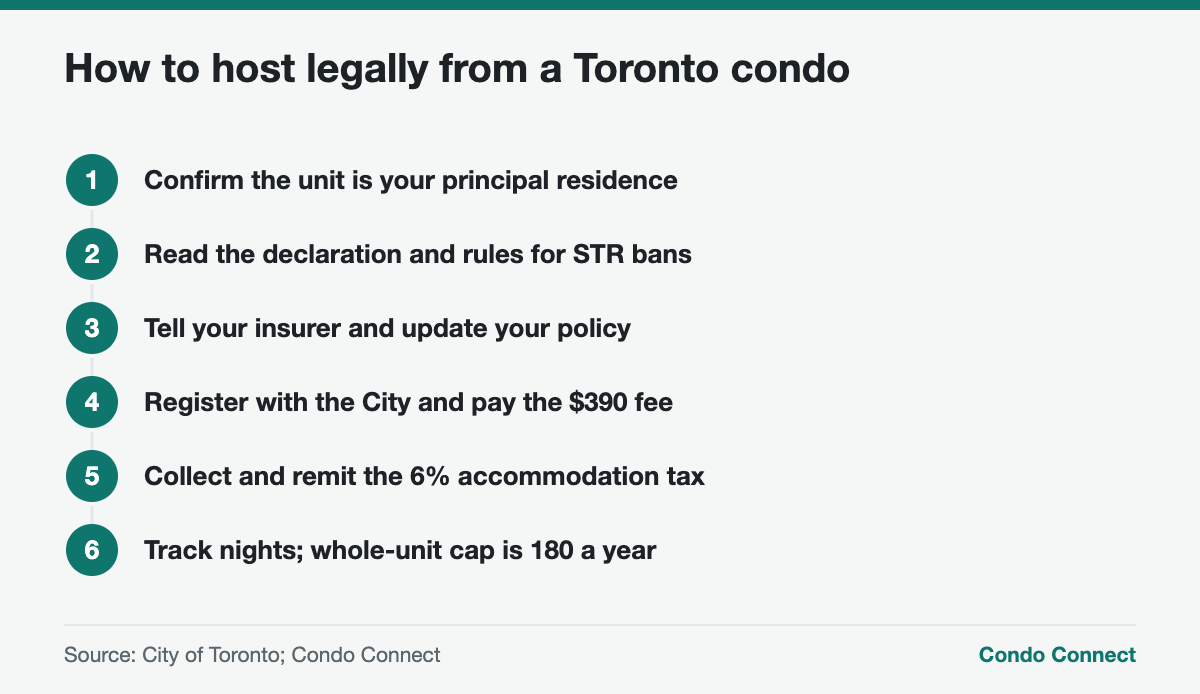
Tip: Call your insurance broker before your first guest arrives. Many condo unit owner policies exclude or limit coverage for commercial or short-term rental activity, and your condo’s by-laws may charge you the corporation’s deductible if a guest causes a leak. Our guide to condo insurance in Ontario explains how that chargeback works.
Does hosting affect your principal residence exemption?
Renting out part of your home occasionally does not usually end its status as your principal residence, provided you live there, make no structural changes for the rental and do not claim capital cost allowance on the unit. Renting the whole unit for up to 180 nights a year while living there the rest of the time is a greyer area. Get tax advice if short-term income is significant relative to how much you use the unit yourself.
Frequently asked questions
Can I Airbnb my condo in Toronto if I don’t live there?
No. Toronto permits short-term rentals, meaning stays under 28 consecutive days, only in the operator’s principal residence. An investment condo you do not live in can be rented for 28 days or longer, subject to your condo’s rules and the Residential Tenancies Act where it applies, but not listed for nightly stays.
What happens if my condo bans short-term rentals and I host anyway?
The corporation can demand that you stop, and if you do not, it can pursue legal action to enforce its documents. Owners who breach governing documents are often ordered to pay the corporation’s legal costs. You may also face City enforcement if you are not properly registered, and the CRA can deny your rental expenses.
How many nights can I rent my condo in Toronto?
If you rent out the entire unit while away, the City caps it at 180 nights a year. If you rent out a room while you live in the unit, there is no nightly cap. In both cases the unit must be your principal residence and registered with the City, and your condo’s own rules may be stricter.
Do I have to charge the Municipal Accommodation Tax?
Yes. Toronto requires the 6% Municipal Accommodation Tax to be collected on short-term rental stays. Some platforms collect and remit it for hosts, while in other cases the host is responsible. Check how your platform handles it and keep records, because the obligation stays with you as the registered operator.
Buying a condo you might rent out?
Compare long-term rental numbers with our analysis of renting vs buying a Toronto condo, browse Toronto condos for sale, or ask our team which buildings permit the leasing you have in mind.
This article is general information as of October 2026, not legal, tax, mortgage or financial advice. Rules and numbers change, so confirm the details for your situation with a licensed professional.