
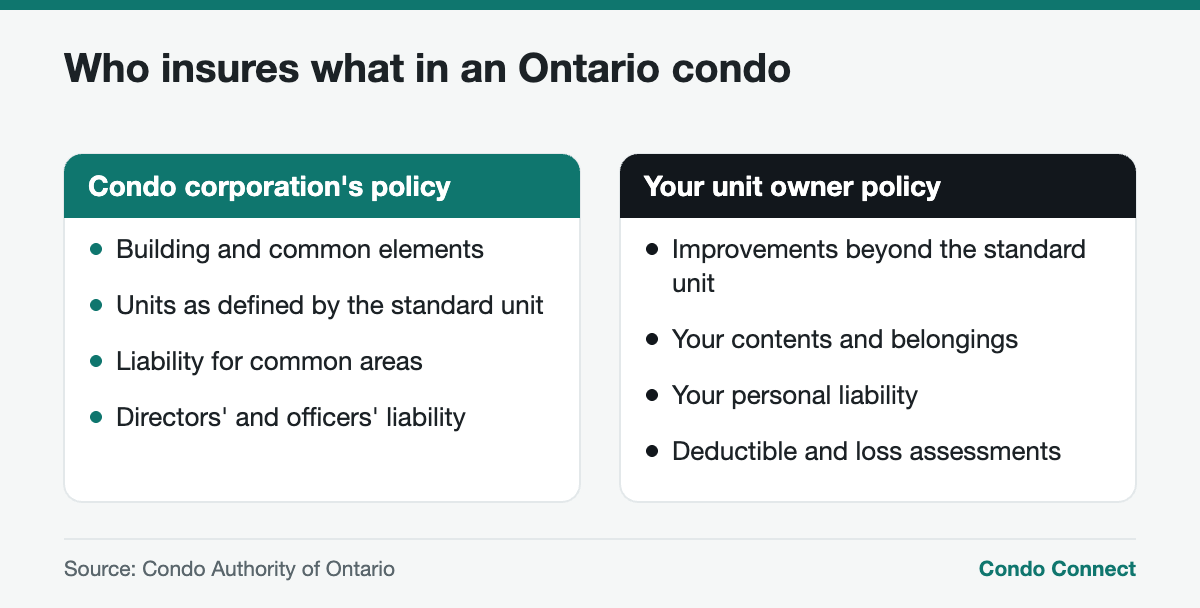
In Ontario, your condo corporation must insure the building, the common elements and the units up to the “standard unit” defined in its documents, but that policy does not cover your upgrades, your belongings or your personal liability. You need your own condo unit owner policy for those, and it should include coverage for the corporation’s deductible, because by-laws can pass that deductible to you if damage starts in your unit.
Key takeaways
- The corporation’s policy covers the standard unit; anything beyond it counts as an improvement you must insure.
- Corporation deductibles range from a few hundred dollars to tens of thousands.
- By-laws can make an owner pay the deductible when damage comes from their unit.
- Match your policy’s deductible assessment coverage to the corporation’s actual deductibles.
- Landlords need a policy designed for rented units, and tenants need their own insurance.
What the condo corporation’s insurance covers
Ontario condo corporations are required by law to carry insurance. According to the Condo Authority of Ontario, the required coverage includes damage to units and common elements from major perils such as fire and flood, liability for failing to keep common areas safe or from machinery, and liability for directors and officers acting in good faith.
That coverage stops at the standard unit. If your unit has been improved beyond that definition, the extra value is your responsibility.
What is a “standard unit”?
The standard unit is the baseline version of each unit type, defined in the corporation’s by-laws or, if there is no by-law, by the original finishes the developer installed. The CAO says standard units generally include walls, doors and plumbing, while appliances and flooring often fall outside the definition.
Anything not in the definition is treated as an improvement or betterment. Common examples in Toronto condos:
- Hardwood or upgraded flooring replacing builder laminate.
- Custom kitchen cabinets, stone counters and higher-end appliances.
- Pot lights, built-in closets and custom millwork.
- Bathroom renovations beyond the original finishes.
If you buy a resale unit that a previous owner renovated, those improvements are now yours to insure. Ask for the standard unit schedule with the status certificate package so you can see the baseline.
The deductible chargeback: the risk most owners miss
When the corporation makes a claim, it pays its policy deductible first. The CAO notes those deductibles range from a few hundred dollars to tens of thousands, and that a corporation’s by-laws can shift the deductible to an owner in more situations than the Act sets out. A common example is damage that starts in your unit and spreads to other units or common elements.
The CAO cites a 2023 Etobicoke case in which an owner was billed about $27,000. Water is the usual culprit: a burst washing machine hose, a cracked toilet supply line, an overflowing tub or a failed dishwasher connection in a high-rise can affect several floors below.
A worked example
Say your corporation’s water damage deductible is $25,000 (a hypothetical figure; check your own building’s). A leak from your dishwasher damages your unit and two units below. If the by-laws assign the deductible to the owner where damage originates, you could be charged up to $25,000. If your policy’s deductible assessment coverage is only $10,000, the remaining $15,000 comes out of your pocket.
| Item | Amount |
|---|---|
| Corporation’s water damage deductible (hypothetical) | $25,000 |
| Your policy’s deductible assessment coverage | $10,000 |
| Uncovered amount you could owe | $15,000 |
Unpaid chargebacks can be added to your common expenses and, like other arrears, can lead to a lien. This is why a cheap policy with low assessment limits can be an expensive mistake.
What your condo unit owner policy should include
- Improvements and betterments beyond the standard unit, at replacement cost.
- Contents: furniture, clothes, electronics and anything in your locker.
- Personal liability, for injury or damage you cause to others, including other units.
- Deductible assessment coverage at least equal to the corporation’s highest relevant deductible.
- Loss assessment coverage for your share of an uninsured or under-insured loss levied on all owners.
- Additional living expenses if you have to move out during repairs.
Ask your broker about water damage, sewer backup and any exclusions for units left vacant for a period, which matters if you travel or are between tenants.
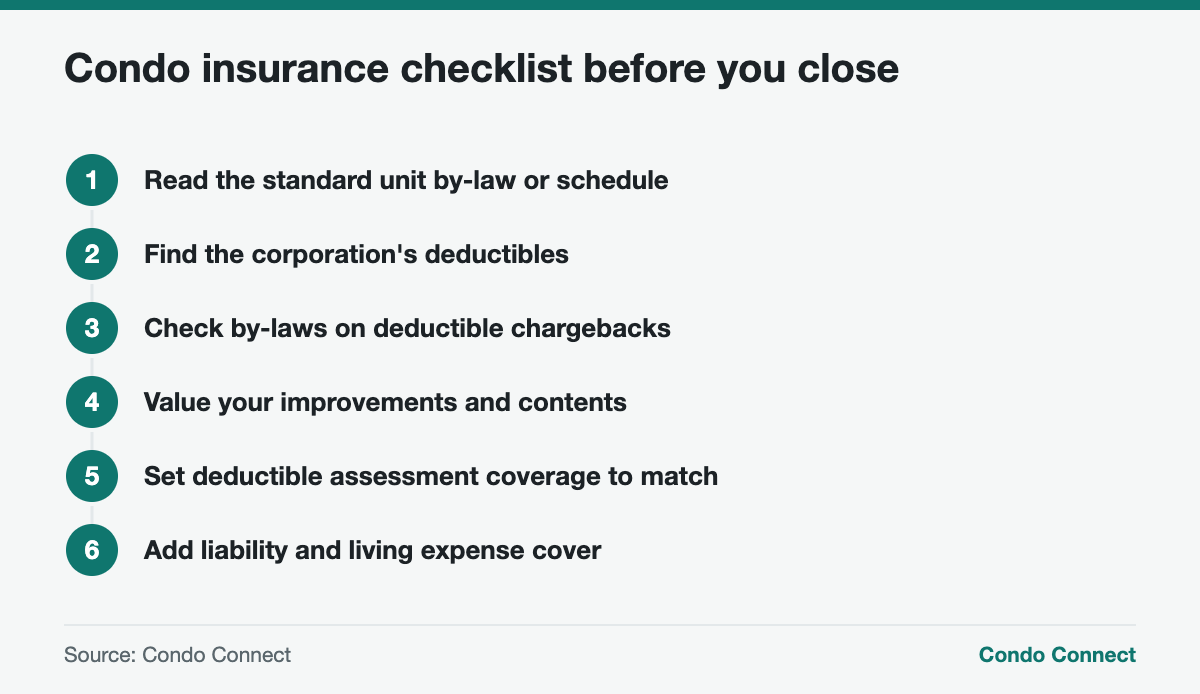
Tip: The status certificate package includes the corporation’s insurance certificate, which shows its deductibles. Before you firm up on a resale condo, send that page to your insurance broker and ask for a quote that matches your coverage to those deductibles. It takes a day, and it prevents the most common gap in Ontario condo insurance. Our status certificate guide shows what else is in the package.
Condo insurance for landlords and tenants
If you rent your condo out, a regular owner-occupier policy may not apply. Landlords generally need a policy written for a rented unit that covers improvements, liability as a landlord, the deductible assessment and loss of rental income after an insured loss. Tell your insurer as soon as the unit is rented.
Tenants need their own tenant policy for contents and liability. Many condo leases require it, and it protects the landlord too, because a tenant’s liability coverage can respond when a tenant’s leak damages the building. For more on renting out a condo, see our explainer on condo rent control in Ontario.
How insurance connects to fees and assessments
The corporation’s insurance premium is part of the operating budget, so rising premiums show up in your maintenance fees. A large uninsured loss, or a deductible the corporation absorbs itself, can also lead to a special assessment. Our articles on Toronto condo maintenance fees and special assessments explain how those costs reach owners.
Frequently asked questions
Is condo insurance mandatory in Ontario?
The corporation must carry its own insurance by law. For owners, the Condominium Act does not require a personal policy, but many corporations’ by-laws or rules do, and mortgage lenders often require proof of coverage. Even where it is optional, going without leaves you exposed to deductible chargebacks, liability claims and the cost of replacing your improvements.
Who pays for water damage in a condo in Ontario?
It depends on where the water came from, what was damaged and what the corporation’s by-laws say. Damage to the standard unit and common elements is usually covered by the corporation’s policy, subject to its deductible. If the leak started in your unit, by-laws may charge you that deductible. Your own policy covers your improvements and contents.
How much does condo insurance cost in Toronto?
Premiums vary with coverage limits, the corporation’s deductibles, the building’s claims history and your own claims record, so there is no reliable average to quote. Ask two or three brokers for quotes using the same coverage amounts, including deductible assessment limits that match your building, so you are comparing like with like.
What is loss assessment coverage in condo insurance?
It covers your share of a special assessment the corporation levies on all owners after an insured loss, for example when a claim exceeds the corporation’s policy limits or the corporation pays a large deductible itself. It is different from deductible assessment coverage, which responds when the deductible is charged to you specifically because the damage started in your unit.
Buying a condo soon?
Read our condo buyers’ guide for the full closing checklist, or browse condos for sale across Ontario and ask for the status certificate early on any unit you are serious about.
This article is general information as of October 2026, not legal, tax, mortgage or financial advice. Rules and numbers change, so confirm the details for your situation with a licensed professional.