A condo special assessment in Ontario is a one-time charge to every owner, on top of regular fees, used when the corporation needs money its budget and reserve fund cannot cover. Owners must pay their share, in a lump sum or instalments, and unpaid amounts can lead to a lien on the unit. The best defence is reading the reserve fund numbers in the status certificate before you buy.
Key takeaways
- Every Ontario condo must keep a reserve fund for major repairs, based on a professional reserve fund study.
- Studies are required within a year of registration and then at least every three years.
- A special assessment is shared by owners in proportion to their units’ common expense percentages.
- The status certificate must show the reserve balance, planned contributions and any special assessments.
- Very low fees in an older building are the most common early warning sign.
What is a reserve fund, and why does it run short?
The reserve fund is a mandatory account used to pay for major repairs and replacements of common elements and assets: roofs, windows, balconies, elevators, garage membranes, boilers and chillers. The Condo Authority of Ontario stresses that contributions must be based on a formal reserve fund study and funding plan, not an arbitrary amount.
Funds run short for predictable reasons. A board keeps fees low for years to please owners. Construction costs rise faster than the study assumed. A component fails earlier than expected. Or an uninsured loss, legal case or insurance deductible lands on the corporation.
How reserve fund studies work in Ontario
According to the CAO’s guide to reserve funds:
- The first study is a comprehensive (Class 1) study, due within one year of registration.
- Updated studies, with or without a site inspection, follow on an alternating basis at least every three years.
- Studies project at least 30 years ahead.
- Before the first study, the corporation must contribute at least the greater of 10% of its operating budget or the amount reasonably expected to fund future major repairs.
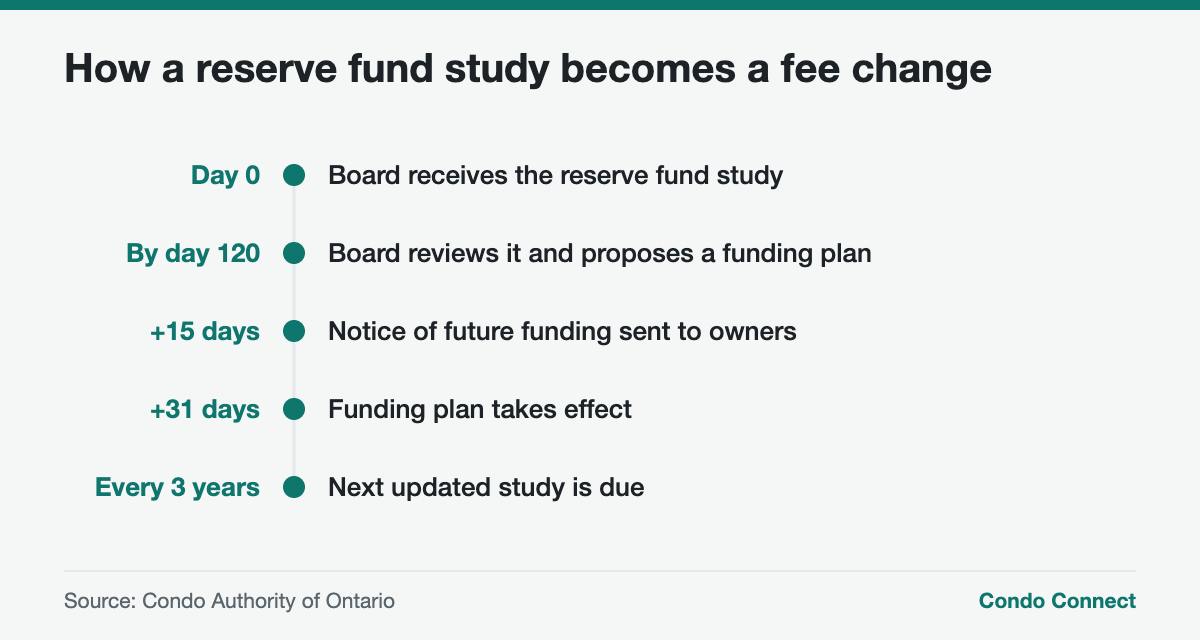
- The board must review a new study within 120 days and propose a funding plan, then send owners a notice of future funding within 15 days. The plan takes effect on the 31st day after the notice.
The board should follow the study’s advice but is not legally bound to. If the notice shows the board planning to contribute less than the study recommends, ask why.
How much can a special assessment cost?
Each unit pays according to its proportionate share of common expenses, a percentage set in the condo’s declaration. Larger units generally carry larger shares.
| Project cost not covered by reserves | Unit’s share of common expenses | Unit’s assessment | If spread over 12 months |
|---|---|---|---|
| $2,000,000 | 0.25% | $5,000 | about $417 a month |
| $2,000,000 | 0.40% | $8,000 | about $667 a month |
These are illustrations, not typical figures; assessments range from a few hundred dollars to tens of thousands per unit, depending on the shortfall and building size. The alternative to an assessment is usually a sharp fee increase for several years, or a loan, which in Ontario requires a borrowing by-law approved by owners.
Do you have to pay a special assessment?
Yes. The CAO notes that owners are collectively responsible for maintaining the corporation’s assets through fees and, if necessary, special assessments. Owners should be told the reason, amount, payment options and alternatives considered. Non-payment can lead the corporation to register a lien against your unit, and lien enforcement costs can be added to what you owe.
If you believe an assessment was charged or disclosed improperly, the CAO says some owners have taken disputes to the Superior Court of Justice. That is expensive, and it does not pause the bill.
Status certificate warning signs
A status certificate costs no more than $100 including tax and must be delivered within 10 days of the request. For reserve funds, it must include:
- The current reserve fund balance.
- The annual reserve contribution for this fiscal year and the unit’s share of it.
- When the last reserve fund study was done or when the next is due.
- Any planned increases in contributions under the funding plan.
- A copy of the most recent notice of future funding.
- Details of any special assessment charged to the unit to increase reserve contributions.
Read these items first, then the budget, the auditor’s statements and any notes about legal actions or insurance claims. Our status certificate guide explains where each appears.
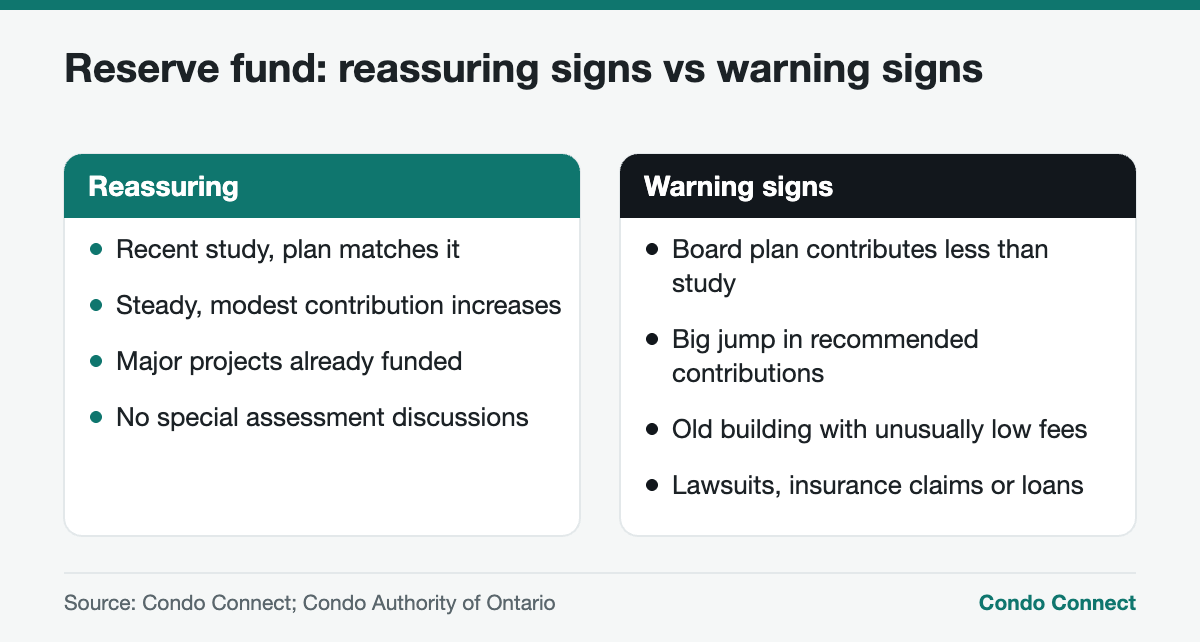
Tip: Compare the reserve fund study’s recommended contributions year by year with what the board actually collects. If the study called for $400,000 this year and the budget shows $250,000, the gap does not disappear; it becomes a future fee hike or special assessment. Ask your lawyer to check whether the minutes mention upcoming projects or assessment discussions.
Who pays a special assessment when a condo sells?
There is no single rule. It depends on when the assessment was levied, when instalments fall due and what the agreement of purchase and sale says. Buyers commonly negotiate for the seller to pay any assessment levied before closing, or for a price reduction to reflect one that has been announced. Make your offer conditional on a satisfactory status certificate review so you can walk away if one appears.
Sellers should disclose known assessments early. Hiding one rarely works, because it shows up in the status certificate and can sink a deal days before it is firm.
How fees and assessments connect
Special assessments and fee increases are two ways of paying for the same thing. A building with modest annual increases that track the study is usually in better shape than one with flat fees for a decade. Our look at Toronto condo maintenance fees in 2026 explains what normal increases look like, and buyers of newer buildings should read our notes on the first reserve fund study in buying an unsold new condo.
Frequently asked questions
Does the board need owner approval for a special assessment?
Generally, owners do not vote on a special assessment for necessary repairs, because it is a common expense the board can levy under the Act and the corporation’s documents. Borrowing is different: a loan requires a borrowing by-law approved by owners. Check your corporation’s declaration and by-laws, and get legal advice if you believe the board overstepped.
Can a special assessment be paid in instalments?
Often, yes. The CAO says a special assessment may be due as a lump sum or in instalments, and owners should be told the payment options. The board sets the terms. If you cannot pay on time, speak with the property manager early; unpaid amounts can lead to a lien, plus legal and collection costs.
How do I know if a condo reserve fund is underfunded?
There is no single threshold. Compare the study’s projected minimum balances with actual balances, look for large jumps in recommended contributions, and check whether the board’s plan differs from the study. Periodic information certificates from the corporation also compare current balances with plans. A consistent shortfall is the warning sign.
Are new condos less likely to have special assessments?
In the early years, usually, because components are new. But some developers set first-year budgets low, and the first comprehensive study, due within a year of registration, can reset contributions sharply. Construction defects can also lead to costs if warranty claims fall short. Newer is lower risk, not no risk.
Buying in a building with a history?
Avoid the traps in our five costly condo buying mistakes, browse condos for sale across Ontario, or contact our team to talk through a status certificate before you firm up.
This article is general information as of October 2026, not legal, tax, mortgage or financial advice. Rules and numbers change, so confirm the details for your situation with a licensed professional.