In October 2026, renting a one-bedroom condo in Toronto is cheaper month to month than owning one, but owning is close to the cost of renting a two-bedroom. On a $550,000 condo with 20% down, the unrecoverable cost of owning (interest, property tax, fees and insurance) is about $2,760 a month, compared with an average one-bedroom condo rent of $2,316 in the City of Toronto. Whether buying wins depends on how long you stay and what prices do.
Key takeaways
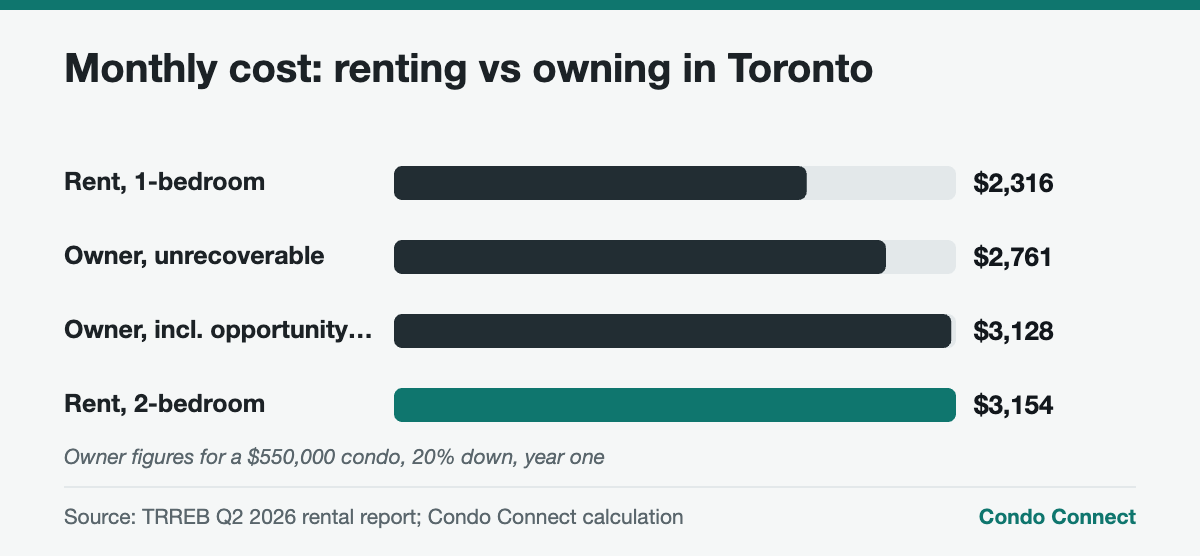
- Average City of Toronto condo rents in Q2 2026 were $2,316 for a one-bedroom and $3,154 for a two-bedroom.
- Owning a $550,000 condo costs about $3,513 a month in cash, but about $752 of that is principal you keep.
- Counting the return you give up on your down payment, owning costs about $3,128 a month in year one.
- Over five years with flat prices, a buyer roughly breaks even after buying and selling costs.
- Buying tends to win the longer you stay, especially if prices recover from 2026 levels.
What renting a condo in Toronto costs now
TRREB’s Q2 2026 rental report put average condo rents in the City of Toronto at $1,862 for a bachelor, $2,316 for a one-bedroom, $3,154 for a two-bedroom and $3,882 for a three-bedroom. Across the GTA, the average one-bedroom rent was $2,273, down 2.3% from a year earlier.
Rents are softer because a large wave of new condos has been completed and leased. For renters, that means more choice and some room to negotiate, and in units first occupied after November 15, 2018, no legal cap on increases at renewal.
What owning a $550,000 Toronto condo costs
We used $550,000, close to the City of Toronto benchmark of $543,800 in September 2026, with 20% down and a 5.09% uninsured 5-year fixed rate over 25 years. Property tax uses the City’s 2026 residential tax rate applied to the price, a simplification because assessed values differ from sale prices.
| Monthly cost of owning | Amount | Recoverable? |
|---|---|---|
| Mortgage interest (year-one average) | $1,830 | No |
| Mortgage principal (year-one average) | $752 | Yes, it becomes equity |
| Property tax (Toronto 2026 rate of 0.767%) | $352 | No |
| Condo fee (assumed) | $550 | No |
| Contents and liability insurance (assumed) | $30 | No |
| Total cash out | $3,513 | |
| Unrecoverable cost | $2,761 |
Owners also give up the return their down payment could earn. At an assumed 4% a year on $110,000, that is about $367 a month, bringing the comparable cost to about $3,128. Repairs inside the unit, such as appliances and flooring, add more over time.
Then there are one-time costs. Land transfer tax on $550,000 in Toronto is $14,950, or $6,475 for an eligible first-time buyer; see our land transfer tax examples. Selling later typically costs several percent of the price in commission and legal fees.
Is it cheaper to rent or buy a condo in Toronto?
Month to month, renting a one-bedroom is cheaper: about $2,316 versus $2,761 of unrecoverable cost for an owner, or $3,128 including the opportunity cost. A two-bedroom renter paying $3,154 is spending about the same as the owner’s all-in unrecoverable cost.
The fair comparison is like for like. A $550,000 condo in Toronto is typically a one-bedroom plus den or a compact two-bedroom, so the true rental equivalent sits between the two averages. In that range, owning and renting are close enough that the decision turns on time and prices, not the monthly bill.
The five-year view
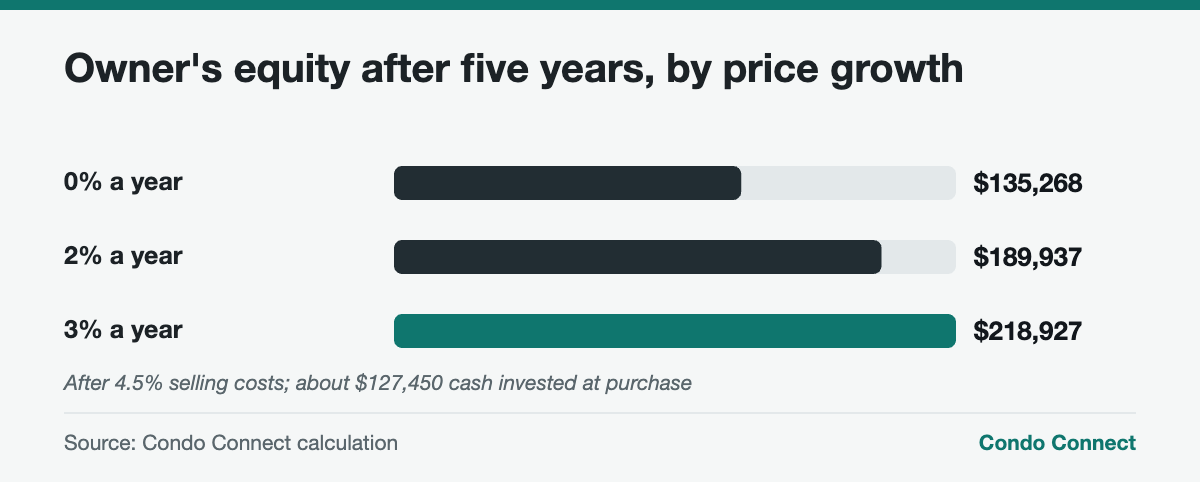
Here is what happens if the owner sells after five years. The buyer put in about $127,450 at the start: the $110,000 down payment, $14,950 in land transfer tax and an assumed $2,500 in legal and closing costs. After five years of payments the mortgage balance is about $389,980. We deducted 4.5% for selling costs.
| Annual price change | Value after 5 years | Equity after selling costs | Versus cash put in |
|---|---|---|---|
| 0% | $550,000 | $135,268 | +$7,818 |
| 2% | $607,244 | $189,937 | +$62,487 |
| 3% | $637,601 | $218,927 | +$91,477 |
With flat prices the owner gets back slightly more than the cash they put in, but the renter could have invested that same $127,450 and the monthly difference. At 2% or 3% annual growth, buying comes out clearly ahead. If prices fell further, the renter would win.
Tip: Compare the specific unit you would buy with the specific units you would rent in the same building. Many Toronto condo buildings have both listings at once, so you can see the exact rent for the exact layout. If the rent is less than the unrecoverable cost of owning and you might move within three years, renting and investing the difference is usually the better money decision.
Factors the numbers miss
- Stability. An owner cannot be asked to leave for a landlord’s own use. A tenant can, with notice and compensation.
- Rent increases. Renters in post-2018 units face no cap on renewal increases; see our explainer on condo rent control.
- Rate risk. Owners renew their mortgage every few years at whatever rates are then. Renters face rent risk instead.
- Special assessments and fee increases. These fall on owners only.
- Forced savings. Principal repayment builds equity whether or not you are disciplined about investing.
When buying beats renting, and when it does not
Buying usually makes sense if
- You expect to stay five years or more.
- Your income is stable and you pass the stress test comfortably.
- The unit’s ownership costs are close to the rent for the same layout.
Renting usually makes sense if
- You may move for work or family within two or three years.
- Buying would use every dollar of your savings, leaving no emergency fund.
- You will actually invest the money you save each month.
First-time buyers with less than 20% down can lower the monthly cost with a longer amortization; our 30-year amortization guide shows the trade-offs.
Frequently asked questions
How much is rent for a condo in Toronto in 2026?
In Q2 2026, TRREB reported average condo rents in the City of Toronto of $1,862 for a bachelor, $2,316 for a one-bedroom, $3,154 for a two-bedroom and $3,882 for a three-bedroom. Across the wider GTA, average rents were lower and had fallen about 2% year over year as new supply was completed.
How long do you need to own a condo to beat renting?
Often five years or more in Toronto, because buying and selling costs are high. In our example, a buyer who sold after five years with flat prices roughly broke even on the cash invested. With annual price growth of 2% to 3%, buying pulled clearly ahead. Shorter stays usually favour renting.
Is buying a condo in Toronto a good investment in 2026?
For someone living in the unit, it can be, because prices are lower than in recent years and supply of new condos will shrink after 2026. For an investor relying on rent, many units do not cover costs at today’s rates and rents. Run the numbers on the specific unit before deciding.
What costs do condo owners pay that renters do not?
Mortgage interest, property tax, condo fees, special assessments, land transfer tax, legal fees, and repairs inside the unit such as appliances and flooring. Owners also give up investment returns on their down payment. In exchange, they build equity through principal repayment and benefit from any increase in value.
Test it on a real unit
Plug your own price, rate and fees into our rent vs buy and mortgage calculators, then browse Toronto condos for sale to compare with the rents in the same buildings.
This article is general information as of October 2026, not legal, tax, mortgage or financial advice. Rules and numbers change, so confirm the details for your situation with a licensed professional.