A condo parking spot or locker in Ontario is held in one of three ways: as its own legal unit with separate title, as an exclusive-use common element assigned to your suite, or rented from the corporation or another owner. The type decides whether it can be sold separately, whether you pay extra fees and property tax on it, and whether land transfer tax applies. Check the declaration and status certificate before you assume a spot comes with the unit.
Key takeaways
- An owned parking unit has its own title, fee share and usually its own tax assessment.
- An exclusive-use space is part of the common elements and normally stays with the suite.
- Non-residents pay Ontario’s 25% speculation tax on standalone parking and storage units.
- Toronto removed most parking minimums for new developments, so many new units have no spot.
- Owners have a legal process to request an EV charger, and boards can refuse only on narrow grounds.
Three ways condo parking and lockers are held
1. Owned parking or locker unit
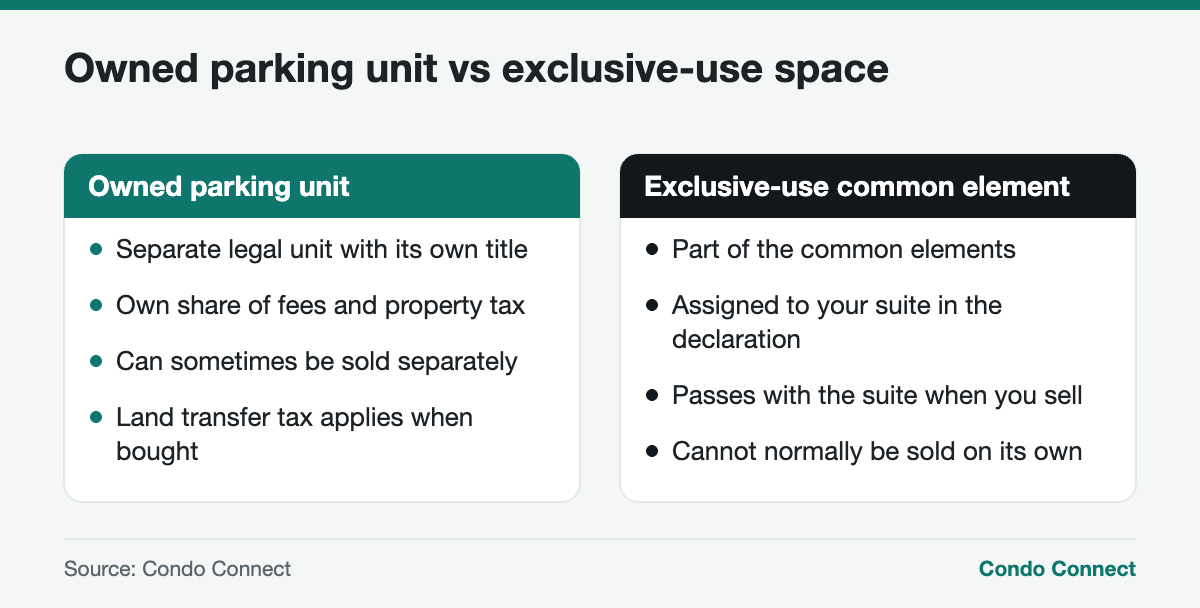
The space is a separate legal unit in the condominium, with its own parcel number on title. It carries its own share of common expenses, which you will see as a separate line on the fee breakdown, and is often assessed separately for property tax. Some declarations allow owned parking units to be sold to other owners in the building; many restrict sales to people who own a suite there.
2. Exclusive-use common element
The space belongs to the common elements, but the declaration gives the owner of a specific suite the exclusive right to use it. It passes automatically with the suite when you sell and generally cannot be sold on its own. Some declarations allow exclusive-use spaces to be swapped between owners with board approval.
3. Rented or licensed space
Some buildings rent spaces from the corporation’s own inventory, or owners rent out spaces they do not need. This is a contract, not ownership, and can end. If you are relying on a rented spot, ask how long the arrangement can last and what it costs each month.
How to tell which type you are buying
- Read the listing carefully: “owned,” “exclusive use” and “rental” mean very different things, and listings are not always accurate.
- Ask for the parking and locker unit numbers, or the exclusive-use designation, in the agreement of purchase and sale.
- Check the status certificate, which identifies units and exclusive-use areas tied to the suite. Our status certificate guide shows where.
- Have your lawyer search title. An owned parking unit will show up as its own parcel.
- Confirm the monthly fee for each separately owned unit, so you know the true cost.
Taxes and costs on condo parking
If you buy an owned parking unit, land transfer tax applies to its price, just as it does to the suite. Bought with the suite, it simply adds to the total price; bought on its own for, say, $60,000, the Ontario land transfer tax would be $325, with the same again in Toronto. Our land transfer tax guide shows the rates.
For buyers who are not Canadian citizens or permanent residents, Ontario’s Non-Resident Speculation Tax of 25% has applied to standalone condo parking and storage units since March 27, 2024. On a $60,000 space that is $15,000 in additional tax.
Owned parking and locker units also carry their own condo fees. When you compare buildings, add those to the suite’s fee; our article on Toronto condo maintenance fees explains how to compare on a per-square-foot basis.
Why more new Toronto condos have no parking
In December 2021, Toronto City Council removed most minimum parking requirements for new developments and introduced maximums, as reported by UrbanToronto. The goal was to reduce car dependency and stop forcing developers to build expensive underground spaces buyers did not want.
The result is that many new buildings, especially near transit, offer far fewer spaces than suites. When buying from a developer, parking is often sold separately and is a useful negotiation point; see our guide to buying an unsold new condo. When reselling a unit without parking, expect a smaller buyer pool in buildings where most suites have a spot.
Tip: If you do not own a car, a unit without parking can be a genuine bargain, as long as the price difference between similar units with and without a spot is larger than what renting one would cost over the years you plan to own. Check recent sales in the same building with and without parking, and ask management whether owners rent out spaces and at what typical monthly price.
EV chargers in condo parking
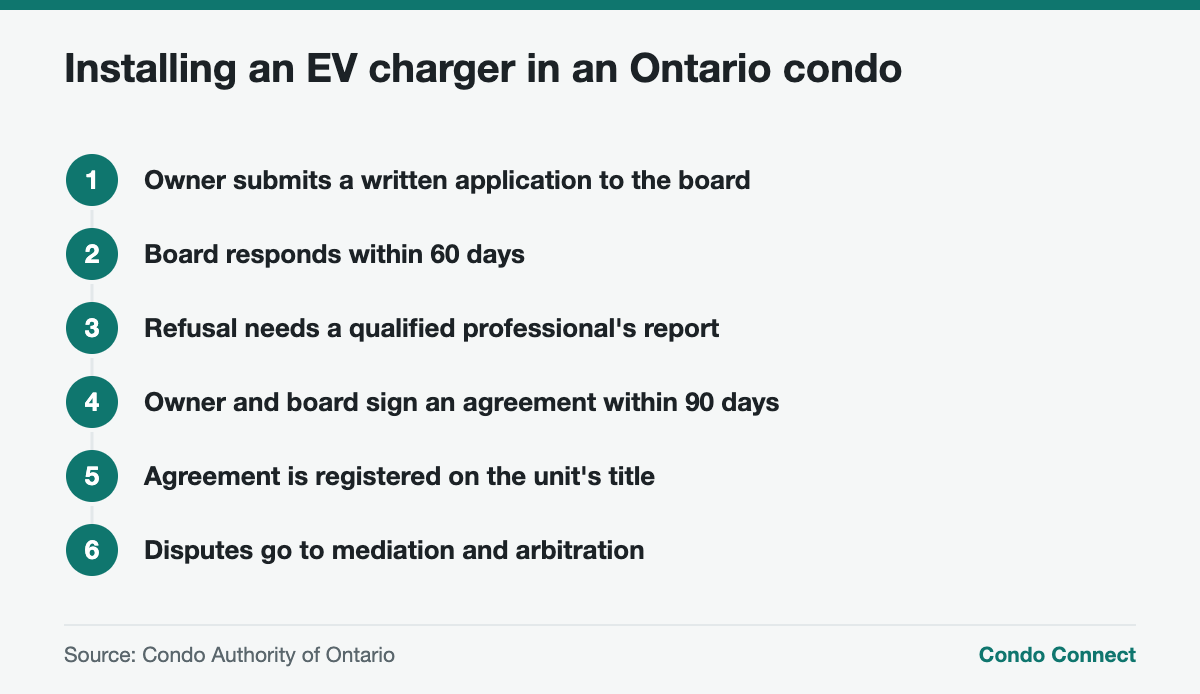
Ontario gives condo owners a defined process to request an electric vehicle charger. Under the rules summarized by the Condo Authority of Ontario:
- The corporation must respond in writing within 60 days of your application, unless both sides agree to extend.
- It can refuse only if a qualified professional’s report shows the installation would break the law, harm structural integrity or create a health and safety risk, and it must give you that report.
- Otherwise it must accept or propose an alternative that does not create unreasonable costs for you.
- You generally pay installation costs. You and the corporation have 90 days after acceptance to sign an agreement, which must be registered on your unit’s title before it takes effect.
- Disputes go to mediation and arbitration within six months.
Parking disputes and the Condo Authority Tribunal
The Condominium Authority Tribunal can hear disputes about provisions in governing documents on parking and storage, vehicles, and pets, among other issues, according to the Condominium Management Regulatory Authority of Ontario. That gives owners a lower-cost route than court for problems such as someone using your exclusive-use space or a board enforcing vehicle rules inconsistently.
Frequently asked questions
Can I sell my condo parking spot separately?
Only if it is an owned parking unit and your declaration allows it. Many declarations restrict sales to owners of suites in the same building. An exclusive-use parking space is part of the common elements and normally passes with your suite, so it cannot be sold on its own. Check the declaration and get legal advice before listing.
Is it worth buying a condo without parking in Toronto?
For many downtown buyers without a car, yes, because the unit costs less and fees are lower. The trade-off is resale: buyers who need parking will skip the listing. In buildings near subway or Line 5 stations, and in newer buildings designed with few spaces, a unit without parking is common and less of a disadvantage.
Do I pay property tax on a condo parking spot?
If it is a separately owned parking unit, it is often assessed and taxed separately, so you may see its own tax bill or a combined bill showing both units. An exclusive-use space is part of the common elements and is not taxed separately. Your lawyer can confirm this from the title and tax certificates.
Can my condo board refuse an EV charger?
Only on narrow grounds. The board must respond within 60 days and can refuse only if a qualified professional’s report shows the installation would contravene the law, affect the building’s structural integrity or pose a health and safety risk. It must give you a copy of that report. Otherwise it must accept or offer a reasonable alternative.
Find the right setup
Browse Toronto condos for sale and filter for parking, or ask our team to confirm how parking and lockers are held in a building before you offer.
This article is general information as of October 2026, not legal, tax, mortgage or financial advice. Rules and numbers change, so confirm the details for your situation with a licensed professional.