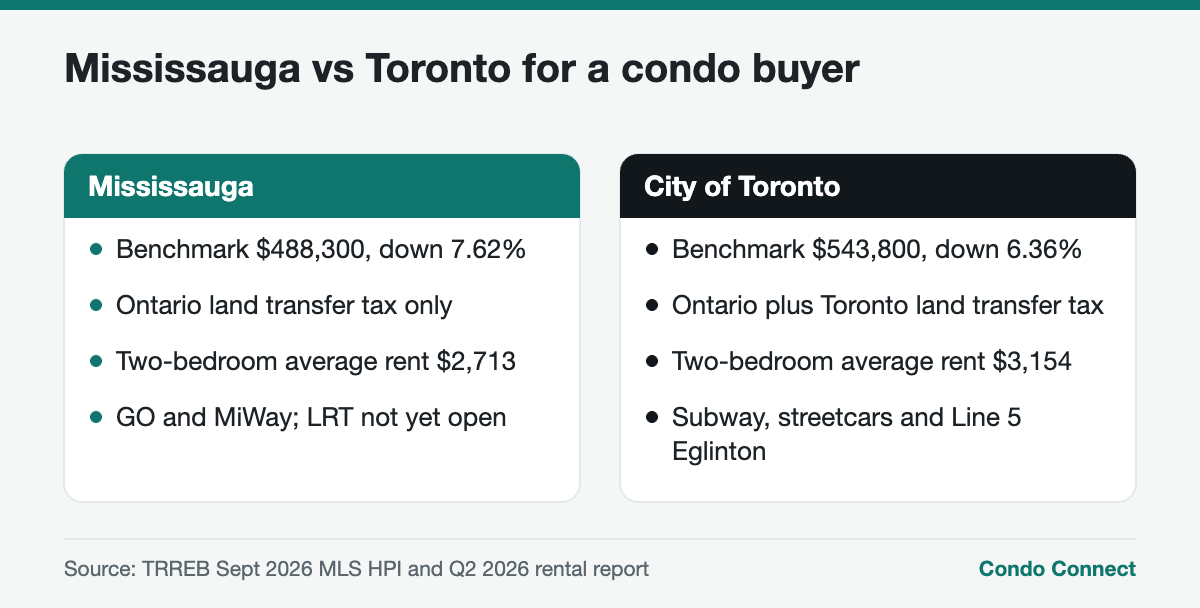
In September 2026 the benchmark condo apartment in Mississauga cost $488,300, about $55,500 (10%) less than the City of Toronto benchmark of $543,800. Mississauga buyers also skip Toronto’s municipal land transfer tax, which saves roughly $7,000 to $8,500 at typical condo prices. Toronto still wins on transit depth and rents, so the right choice depends on where you work and whether you plan to live in the unit or rent it out.
Key takeaways
- Mississauga’s condo benchmark fell 7.62% in a year; Toronto’s fell 6.36%.
- At benchmark prices, total land transfer tax is $6,241 in Mississauga versus $14,702 in Toronto.
- Average two-bedroom condo rent was $3,154 in Toronto and $2,713 in Mississauga in Q2 2026.
- Toronto’s Line 5 Eglinton opened in February 2026; Mississauga’s Hazel McCallion LRT has not opened yet.
- Toronto’s Vacant Home Tax and municipal land transfer tax do not apply in Mississauga.
Condo prices: Mississauga vs Toronto
TRREB’s MLS Home Price Index tracks a benchmark, or typical, condo apartment in each area. It is the fairest way to compare places with different mixes of units.
| Measure (Sept 2026 unless noted) | Mississauga | City of Toronto |
|---|---|---|
| Condo apartment benchmark price | $488,300 | $543,800 |
| Change vs Sept 2025 | -7.62% | -6.36% |
| Ontario land transfer tax at benchmark | $6,241 | $7,351 |
| Toronto municipal land transfer tax | None | $7,351 |
| Total land transfer tax | $6,241 | $14,702 |
| Average two-bedroom condo rent, Q2 2026 | $2,713 | $3,154 |
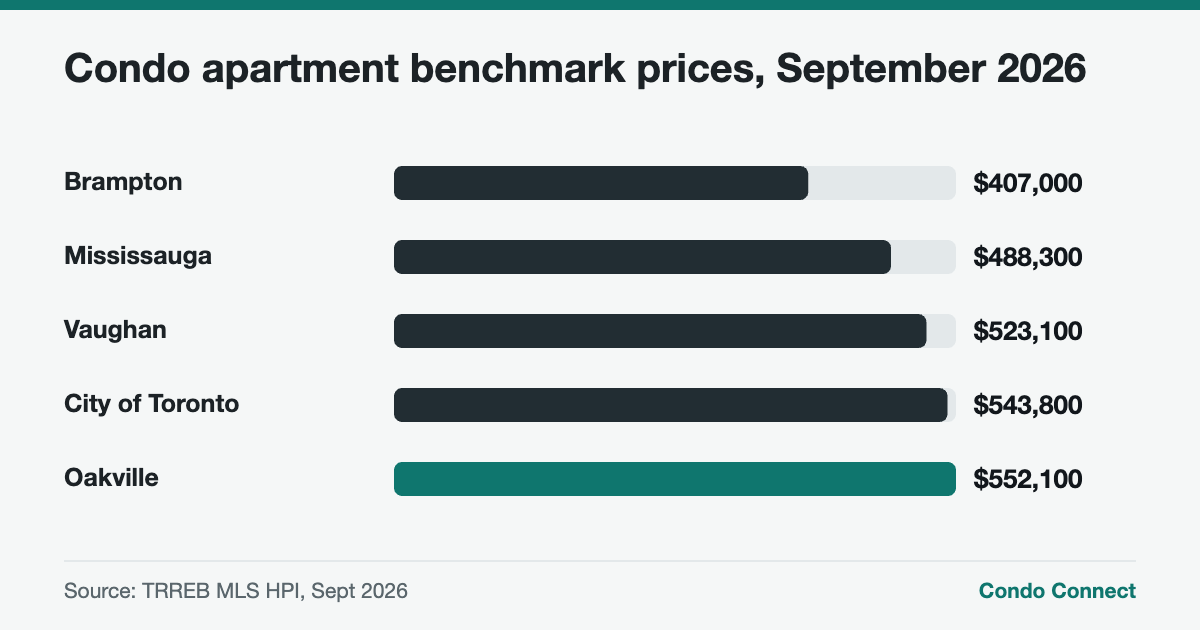
Within Toronto the range is wide. The downtown core district TRREB labels C01 had a benchmark of $550,600, close to the city figure, while several suburban Toronto districts in Scarborough and northwest Etobicoke sat below Mississauga’s level. Nearby alternatives span a wide range too: Brampton’s benchmark was $407,000, Vaughan’s $523,100 and Oakville’s $552,100. Compare specific neighbourhoods, not just city averages; our Mississauga condo market report breaks down local activity.
The land transfer tax gap
Toronto is the only Ontario municipality that charges a municipal land transfer tax, and its rates match the provincial ones below $2 million (see the City of Toronto rate table). On a benchmark-priced condo, a Toronto buyer pays $8,461 more in total land transfer tax than a Mississauga buyer at that city’s benchmark.
First-time buyers narrow the gap. After the Ontario refund (up to $4,000) and Toronto rebate (up to $4,475), the Toronto bill at $543,800 drops to $6,227, while the Mississauga bill at $488,300 drops to $2,241. The difference is still about $3,986, which is real money on closing day. Our full guide to land transfer tax on a Toronto condo has more price points.
Rent and investor considerations
Rents are higher in Toronto. TRREB’s Q2 2026 rental report put the average two-bedroom condo rent at $3,154 in the City of Toronto and $2,713 in Mississauga, a gap of $441 a month, or about 14%. The price gap at the benchmark level is about 10%, so on paper Toronto rents hold up slightly better relative to price.
Other points investors weigh:
- Vacant Home Tax. Toronto charges 3% of assessed value on homes left empty for more than six months of a year, with an annual declaration due April 30. An investor between tenants in Toronto needs to track this; it does not apply in Mississauga.
- Rent control. In both cities, units first occupied after November 15, 2018 are exempt from the rent increase guideline. See our explainer on condo rent control in Ontario.
- Tenant pool. Downtown Toronto draws students and young professionals; central Mississauga draws more commuters and families working in Peel and Halton.
Transit and commute
Toronto’s advantage is transit depth: the subway, streetcars and, since February 8, 2026, Line 5 Eglinton, a roughly 19-kilometre light rail line with 25 stations and stops between Mount Dennis and Kennedy. Condos near Eglinton stations now have rapid transit that was promised for more than a decade.
Mississauga relies on GO Transit (the Lakeshore West and Milton lines), MiWay buses and its bus rapid transitway, with connections to the TTC at Kipling station. The Hazel McCallion LRT along Hurontario Street is not open yet, and local reporting in 2026 pointed to construction continuing into 2027. Buying near a future station is a bet on timing as much as location.
Tip: Before choosing a side of the city line, do the commute at rush hour on a weekday, door to door, from the actual building. A Mississauga condo beside a GO station can beat a Toronto condo a long bus ride from the subway, and a $55,000 price difference can disappear if you end up needing a second car or a parking spot.
Who each city suits
Mississauga makes more sense if
- You work in Peel or Halton, or near a GO line.
- You want more square footage for the money and parking matters to you.
- You are a first-time buyer trying to keep closing costs down.
Toronto makes more sense if
- You want to live without a car and walk to work, shops and transit.
- You are an investor targeting the deepest rental demand.
- You value being on the subway or Line 5 network today rather than an LRT that is still being built.
Questions to answer before you choose
- Where will you work in three years, and how often will you go in?
- What is the all-in monthly cost in each building: mortgage, fees, property tax and parking?
- How many similar units are listed for sale and for lease in each building right now?
- How old is each building, and when is its next reserve fund study due?
- If you sell in five years, which buyer pool is larger for that specific unit?
Answer those honestly and the choice usually makes itself. If the monthly costs are close, transit and resale depth tend to favour Toronto; if they are not, the savings in Mississauga add up quickly.
Frequently asked questions
Are condos cheaper in Mississauga than Toronto?
On average, yes. TRREB’s September 2026 benchmark for a condo apartment was $488,300 in Mississauga and $543,800 in the City of Toronto, a difference of about 10%. Individual Toronto neighbourhoods, especially in Scarborough and northwest Etobicoke, can be cheaper than Mississauga, so compare buildings and districts, not just cities.
Does Mississauga have a municipal land transfer tax?
No. Toronto is the only municipality in Ontario with its own land transfer tax. Condo buyers in Mississauga pay only the Ontario land transfer tax, which is $6,241 on a $488,300 purchase. First-time buyers can get up to $4,000 of that refunded if they meet the eligibility rules.
Is it better to rent out a condo in Toronto or Mississauga?
Toronto rents are higher in dollar terms and its tenant demand is deeper, but purchase prices are higher too. In Q2 2026 the two-bedroom rent gap was about 14% while the benchmark price gap was about 10%. Building-level rent and fee data matter more than city averages, so run the numbers on the specific unit.
When will the Hazel McCallion LRT open?
No firm opening date had been confirmed as of October 2026, and local reports said construction would continue into 2027. The line runs along Hurontario Street through central Mississauga and into Brampton. If you are buying near a future stop, assume the transit benefit is a few years away and check Metrolinx updates.
Compare both sides of the line
Browse Mississauga condos for sale and Toronto condos for sale, or look at Etobicoke, which sits between the two on both price and commute.
This article is general information as of October 2026, not legal, tax, mortgage or financial advice. Rules and numbers change, so confirm the details for your situation with a licensed professional.