Interim occupancy fees in Ontario are monthly payments to the builder made from the day you get the keys to a new condo until the building is registered and you close. The fee is capped at three items: interest on the unpaid balance of your purchase price, an estimate of the unit’s monthly property taxes, and the projected monthly common expenses. On a $650,000 unit with a 20% deposit, that works out to roughly $3,200 a month at today’s rate, none of which reduces what you owe.
Key takeaways
- The fee is interest plus estimated taxes plus estimated common fees, and builders may not profit from it.
- The interest rate is tied by regulation to the Bank of Canada’s posted 1-year conventional mortgage rate, which was 5.49% on October 14, 2026.
- You pay the fee whether or not you move in, and it is not credited to your purchase price.
- Interim occupancy can last from a few weeks to more than a year.
- Your Tarion warranty starts on the interim occupancy date, not at final closing.
What is interim occupancy?
In a new high-rise, units are usually ready to live in before the whole condominium can be registered. Once the municipality says a unit is fit for occupancy, the builder can hand you the keys. You cannot own the unit yet, because title cannot transfer until the condominium is registered, so you occupy it under the terms of your agreement and pay a monthly fee.
Tarion explains that this period can last anywhere from a few weeks to a year or more, depending on how far construction has progressed and what the municipality requires before registration. Lower floors tend to be occupied first, which often means a longer occupancy period.
How are condo occupancy fees calculated?
The Condominium Act limits the fee to the total of three components, as the Condo Authority of Ontario’s Condominium Buyers’ Guide sets out:
- Interest on the unpaid balance of the purchase price.
- Estimated monthly municipal taxes for the unit.
- Projected monthly common expenses, meaning the expected condo fee.
Legal commentary on the Act notes that the interest rate is tied by regulation to the Bank of Canada’s rate for conventional 1-year mortgages, using the rate in effect on the first day of the month in which occupancy happens. On October 14, 2026, the Bank of Canada’s posted rate table showed that rate at 5.49%. It is a posted rate, so it is higher than the discounted rates you would actually get from a lender.
A worked occupancy fee example
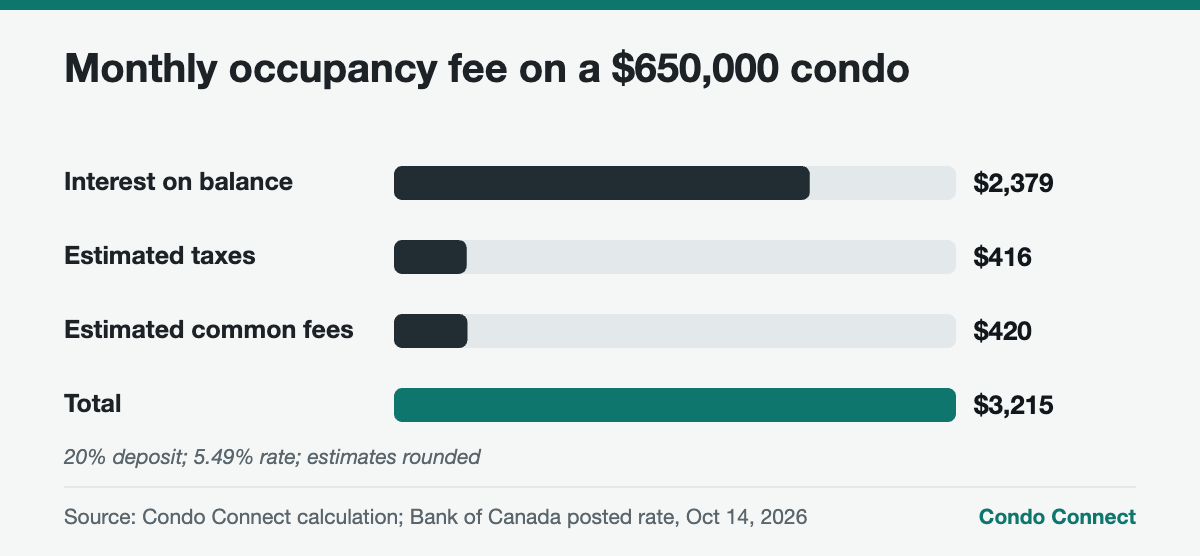
Say you bought a 600-square-foot Toronto unit for $650,000 and paid a 20% deposit ($130,000). The unpaid balance is $520,000.
| Component | How it is estimated | Monthly amount |
|---|---|---|
| Interest | $520,000 x 5.49% / 12 | $2,379 |
| Property tax estimate | $650,000 x 0.767% (Toronto 2026 residential rate) / 12 | $416 |
| Common expenses estimate | Assumed $0.70 per sq ft x 600 sq ft | $420 |
| Total occupancy fee | $3,215 |
The tax line uses the City of Toronto’s 2026 total residential rate of 0.767311% applied to the price as a stand-in; the builder will use its own estimate, and the real assessment comes later. The fee line is an assumption, so substitute the figure in your disclosure statement budget.
Over six months of occupancy that is about $19,300, and over twelve months about $38,600. With only a 10% deposit, the interest line alone rises to about $2,676 a month.
Do occupancy fees go toward the purchase price?
No. Tarion states plainly that occupancy fees are not credited to the purchase price. Think of them as rent paid to the builder. The builder uses them to cover its own costs on your unit and, under section 80 of the Act as described in legal commentary, may not profit from them.
That is why interim occupancy is sometimes called “phantom rent.” The cost is real, the equity is not.
How to keep interim occupancy costs down
- Know your probable occupancy date early. Your agreement’s tentative and firm occupancy dates, and the builder’s notices, tell you when the clock may start.
- Budget for a long period. Plan for 12 months even if the builder suggests fewer, so a shorter period is a bonus rather than something your budget depends on.
- Consider paying down the balance. The interest is calculated on the unpaid balance, so a larger payment at occupancy can lower the fee. Speak with your lawyer first, because Tarion’s condo deposit protection is capped at $20,000 and extra money paid before title transfers carries risk.
- Check whether you can lease during occupancy. Some agreements restrict leasing before final closing. If you plan to rent the unit out, read that clause carefully.
- Do not give notice on your current home too early. Paying rent and an occupancy fee at once is common and expensive.
Tip: Register on Tarion’s MyHome portal as soon as your interim occupancy starts. Your warranty clock begins on that date, and deadlines for submitting your 30-day and year-end defect forms run from it. Walk the unit at the pre-delivery inspection with a checklist and take dated photos of every scratch and gap.
What happens at final closing?
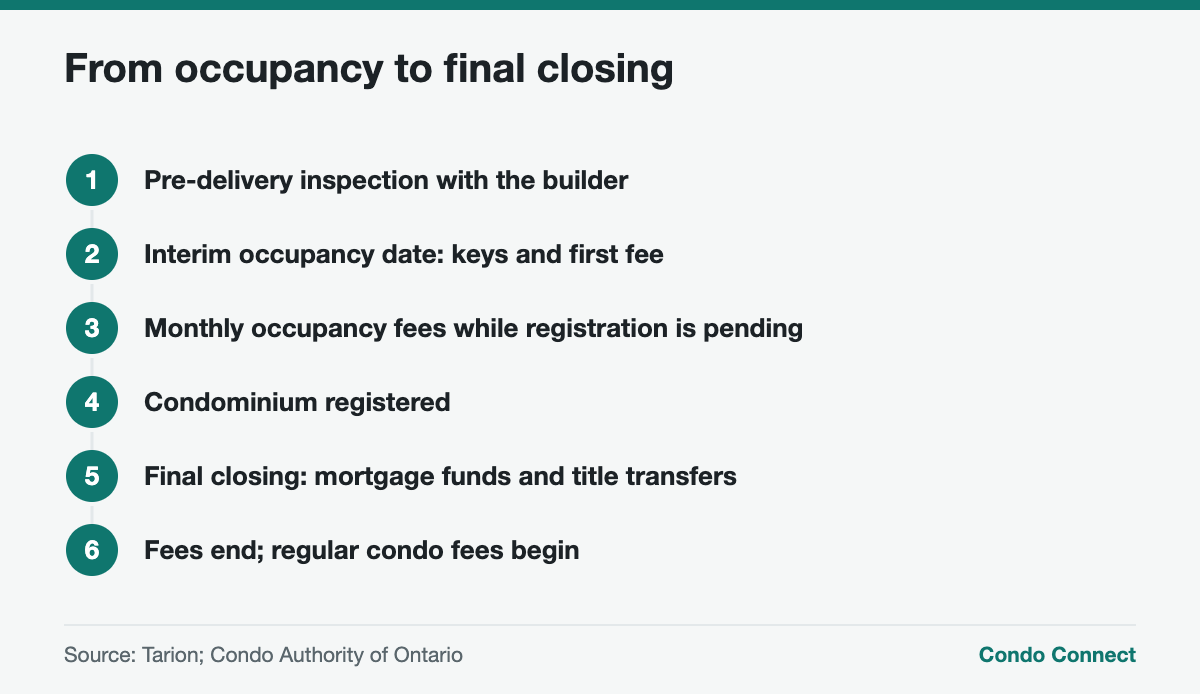
When the condominium is registered, the builder sets a final closing date. Your mortgage funds, title transfers to you, and you pay land transfer tax and the closing adjustments in your agreement. From that point the occupancy fee stops and you pay regular condo fees to the corporation and property tax to the city.
Your lender will appraise the unit before final closing. If resale prices in the building are below your contract price, the appraisal can come in short; our guide to the pre-construction condo appraisal gap covers what to do. It also helps to compare the projected fee in your disclosure budget with what similar buildings charge, using our look at Toronto condo maintenance fees.
Frequently asked questions
How long does interim occupancy last in Toronto?
Anywhere from a few weeks to more than a year, according to Tarion. It ends when the condominium is registered and final closing happens. Units on lower floors are often finished first, so their owners can face longer occupancy periods. Your builder should send notices as registration approaches, but there is no fixed maximum period.
Do I have to pay occupancy fees if I don’t move in?
Yes. Once the builder gives you possession under your agreement, the monthly fee is payable whether you live there, leave it empty or have not picked up the keys. Delaying the move does not delay the fee. Budget for the fee from the interim occupancy date set out in the builder’s notice.
Can a builder charge more than the three components?
The occupancy fee itself is limited to interest, estimated taxes and projected common expenses. Separate closing adjustments, such as development charges, utility connections or Tarion enrolment, are set by your agreement and are paid at closing, not through the monthly fee. If a monthly charge looks higher than the formula allows, ask your lawyer to review it.
Are occupancy fees tax deductible?
Not if you live in the unit. If the unit is a rental property and you lease it during occupancy where your agreement allows, the interest and expense portions may be deductible against rental income. The rules depend on how the fee is characterized, so speak with an accountant before filing.
Plan your closing budget now
Use our buyer calculators to model occupancy and closing costs, read the pre-construction buying guide, or contact our team if you are weighing a sale before final closing.
This article is general information as of October 2026, not legal, tax, mortgage or financial advice. Rules and numbers change, so confirm the details for your situation with a licensed professional.