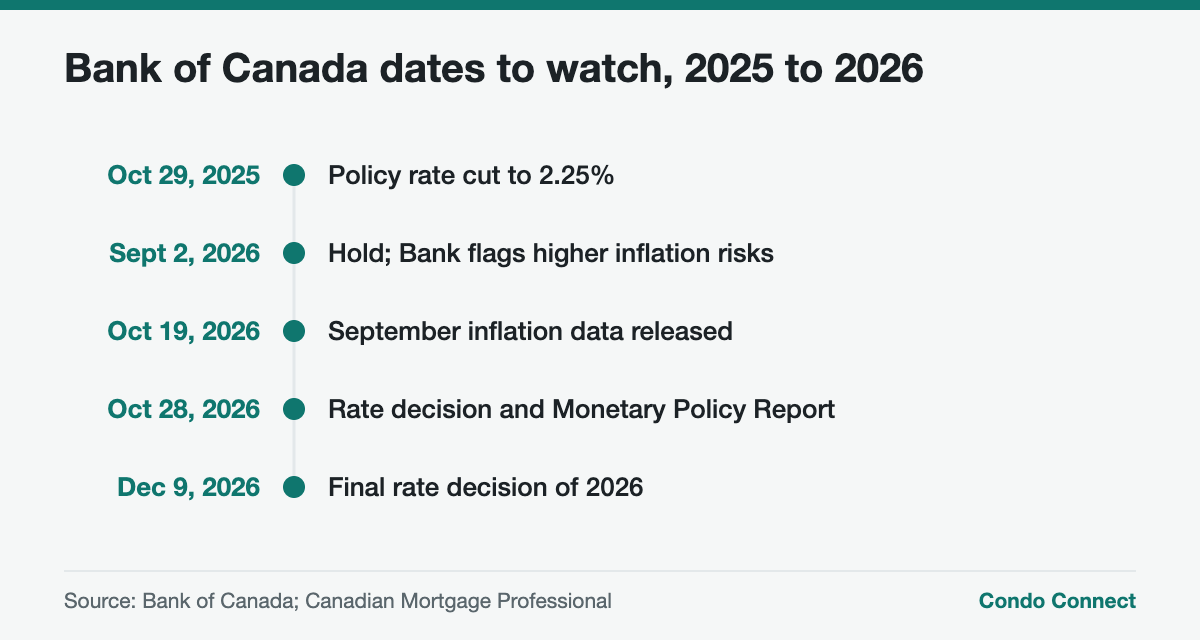
The Bank of Canada announces its next rate decision on Wednesday, October 28, 2026 at 9:45 a.m. ET, with its policy rate at 2.25%. Most economists expect a hold, but a hike is possible, and fixed mortgage rates have already risen because bond yields moved first. For condo buyers and owners, the practical response is the same either way: lock in a rate hold if you are buying soon, and check your renewal options early.
Key takeaways
- The policy rate has been 2.25% since October 29, 2025, and the prime rate is 4.45%.
- After a weak September jobs report, economists surveyed by Canadian Mortgage Professional mostly expected a hold.
- A quarter-point hike adds about $60 a month to the payment on a $450,000 variable mortgage.
- Fixed rates track bond yields and rose at all six big banks between September and mid-October.
- Renewing with a new lender on a straight switch does not require a new stress test.
What is expected on October 28?
The Bank has held at 2.25% at every 2026 meeting so far. In September it said upside risks to inflation had increased, which is central-bank language for “we are watching for a reason to raise.” Some analysts said a hike was possible at one of the last two meetings of the year.
The data since then have cooled that talk. Canada lost 68,300 jobs in September and unemployment rose to 6.5%. In a roundup published after that report, five economists largely expected the Bank to hold, and TD’s Andrew Hencic noted markets were pricing about a 27% chance of an October hike. Earlier, in September, economists at RBC and Desjardins had said they expected the Bank to stay put for the rest of 2026 and raise rates in early 2027.
The September inflation release on October 19 is the last major data point before the decision. The Bank also publishes its quarterly Monetary Policy Report on October 28, according to its 2026 announcement schedule, which will show its updated inflation forecast.
How the decision changes condo mortgage payments
Only variable-rate mortgages and lines of credit move directly with the Bank’s decision, because they are priced off prime. The best discounted 5-year variable rates are around 3.40% to 3.45%, roughly prime minus 1.0%.
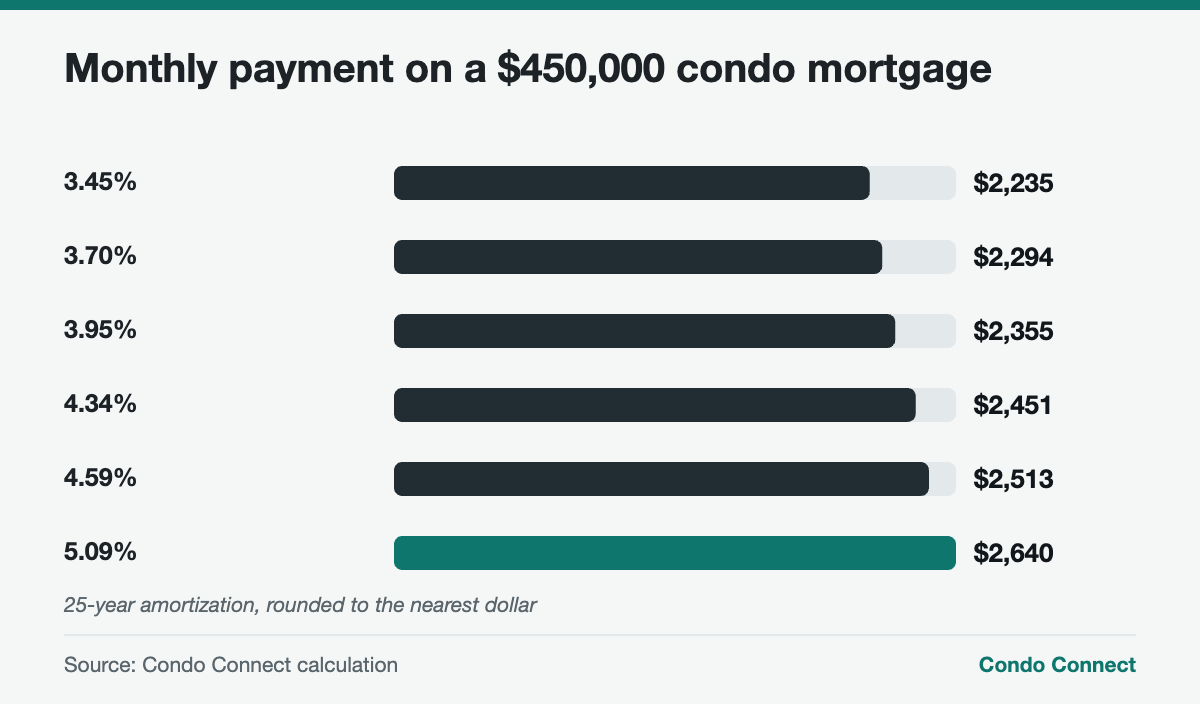
Here is what different rates mean on a $450,000 mortgage, about what you would borrow with 20% down on a $560,000 condo, over 25 years.
| Rate | What it represents | Monthly payment |
|---|---|---|
| 3.45% | Low-end 5-year variable today | $2,235 |
| 3.70% | Variable after a 0.25% hike | $2,294 |
| 3.95% | Variable after two hikes | $2,355 |
| 4.34% | Low-end insured 5-year fixed | $2,451 |
| 4.59% | Typical insured 5-year fixed | $2,513 |
| 5.09% | Typical uninsured 5-year fixed | $2,640 |
Many variable mortgages in Canada have fixed payments, so a hike may first show up as more interest and less principal paid each month rather than a higher payment. Ask your lender which type you have.
Why fixed rates rose before the Bank did anything
Five-year fixed mortgage rates follow the 5-year Government of Canada bond yield, which hit a 52-week high of 3.729% on September 28. All six big banks raised fixed rates between September and mid-October; BMO’s 5-year fixed, for example, went to 5.14% uninsured on October 7.
Comparison sites show the best discounted 5-year fixed rates at about 4.3% to 4.6% for insured mortgages, with uninsured rates higher. Even a hold on October 28 will not necessarily bring fixed rates down if bond yields stay where they are.
Fixed or variable for a condo mortgage right now?
The spread between the best variable and the best insured fixed rate is roughly 0.9 to 1.2 percentage points. A variable rate starts cheaper and benefits if the Bank eventually cuts; a fixed rate protects you if it hikes.
- Variable suits buyers with room in their budget and stable income who can absorb a couple of hikes.
- Fixed suits first-time buyers stretched to qualify, and investors whose rent barely covers costs.
- A shorter fixed term (2 or 3 years) is a middle path if you expect rates to be lower at renewal, but it is a bet like any other.
Condo fees matter to qualifying. Lenders add part of your monthly fee to your housing costs when they calculate your debt ratios, so a high-fee building can reduce what you are approved for. See our notes on condo maintenance fees before you settle on a building.
Renewing a condo mortgage in late 2026
Owners who bought or refinanced in 2021 are renewing now at much higher rates. As an illustration, take a hypothetical $500,000 mortgage at 2.0% over 25 years. The payment was about $2,117 a month, and after five years the balance would be about $418,850. Renewing that balance over the remaining 20 years at 4.34% puts the payment near $2,605, an increase of about $488. At a 3.45% variable rate it would be about $2,413.
The good news is that switching lenders is easier than it used to be. Under OSFI’s minimum qualifying rate rules, a straight switch at renewal to another federally regulated lender does not require the stress test as long as the loan amount and amortization do not increase. Insured borrowers can switch without a new stress test too.
Tip: Most lenders will hold a renewal rate for 120 days before your maturity date. If your condo mortgage renews before early 2027, request offers from your current lender and at least one other now. If rates rise after October 28 you keep the held rate, and if they fall you can usually take the lower one.
What condo buyers and investors should do before October 28
- Get a full pre-approval with a rate hold, not just an online estimate.
- Run your numbers at your rate plus 1% to make sure the purchase still works.
- If you are closing on a pre-construction unit, confirm your appraisal and financing early; our guide to the pre-construction condo appraisal gap explains why.
- Investors: compare the after-hike payment plus fees and taxes with realistic rent, not last year’s rent.
- Use our mortgage calculators to test fixed and variable scenarios side by side.
Frequently asked questions
Will the Bank of Canada raise rates on October 28, 2026?
Nobody knows for certain. After September’s weak jobs report, most economists quoted in Canadian Mortgage Professional expected a hold, and markets priced roughly a 27% chance of a hike at that time. The Bank has warned that inflation risks have risen, so a hike in December or early 2027 remains possible.
Does the Bank of Canada rate affect fixed mortgage rates?
Only indirectly. Fixed rates are priced off Government of Canada bond yields, which react to expectations about inflation and future Bank decisions. That is why fixed rates rose in September and October 2026 even though the Bank held its rate. Variable rates move directly when prime changes after a Bank decision.
What is the prime rate in Canada right now?
The prime rate at the big banks is 4.45%, according to the Bank of Canada’s posted rates table, unchanged since the October 2025 cut to 2.25%. If the Bank raises its rate by 0.25% on October 28, prime would normally rise to 4.70% within a day or two.
Should I lock in my variable mortgage before the decision?
Locking in converts you to a fixed rate at your lender’s current fixed rate, which is higher than most variable rates today. It makes sense if you cannot absorb higher payments or want certainty. If you have room in your budget, a single possible hike may cost less than the higher fixed rate you would lock into.
Thinking about buying before rates move?
Read our look at whether now is a good time to buy a Toronto condo, browse condos for sale across Ontario, or talk to our team about buildings that fit your approved budget.
This article is general information as of October 2026, not legal, tax, mortgage or financial advice. Rules and numbers change, so confirm the details for your situation with a licensed professional.