
A pre-construction condo appraisal gap is the difference between the price you agreed to pay the builder and the lower value your lender’s appraiser puts on the unit at closing. Lenders lend against the lower of the two numbers, so the gap has to come out of your pocket, from a better financing structure, or from a deal with the builder. If you close in the next year, you need a plan at least three months out.
Key takeaways
- Your lender bases the mortgage on the appraised value when it is lower than your contract price.
- On a $750,000 unit that appraises at $600,000, a 20% deposit and an 80% mortgage leave a $120,000 hole.
- If you will live in the unit, an insured mortgage on a new build can shrink the gap a lot, and allows a 30-year amortization.
- Builders do negotiate in 2026: credits, vendor take-back mortgages and unit swaps are all on the table.
- Walking away usually costs more than your deposit, so get legal advice before missing a closing date.
Why so many Toronto pre-construction condos are appraising low
Most units closing now were sold in 2021 and 2022, near the top of the market. Appraisers do not care what the builder charged; they look at what similar units actually sold for recently. That evidence has moved a long way.
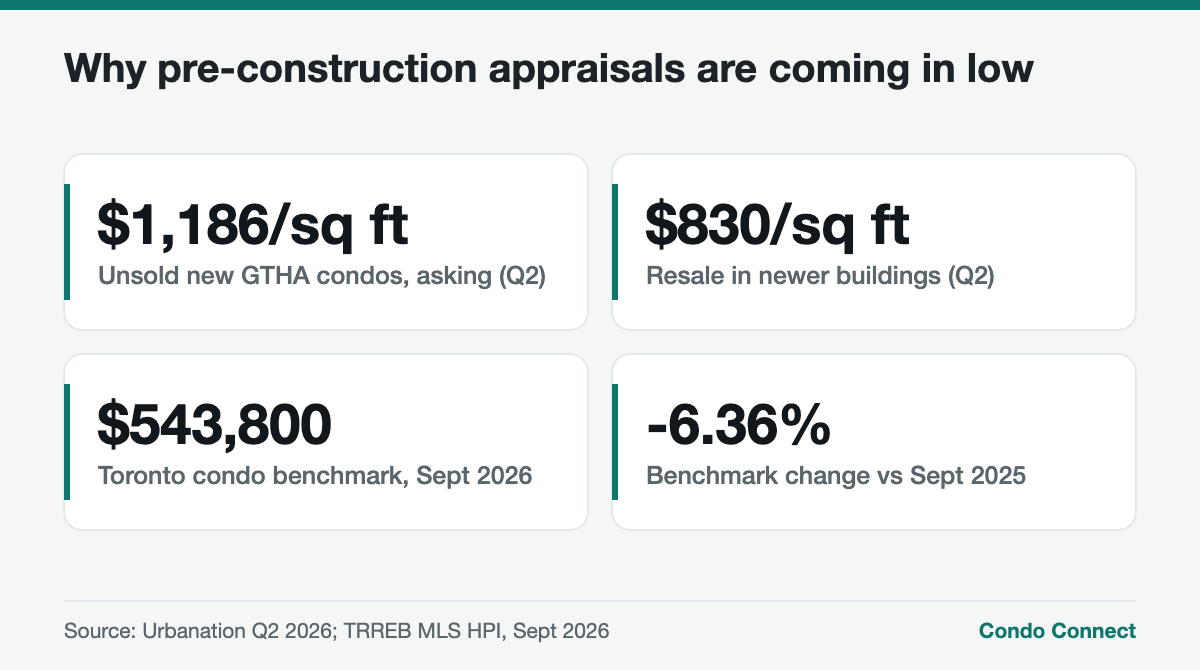
Urbanation reported that in the second quarter of 2026, unsold completed units in the GTHA were asking about $1,186 per square foot, while resale units in recently registered buildings were trading around $830 per square foot. TRREB’s MLS HPI benchmark for a City of Toronto condo apartment was $543,800 in September 2026, down 6.36% from a year earlier.
Put those together and the problem is plain: a contract signed at new-build pricing is being appraised against resale comparables, which are about 30% cheaper per square foot.
How to calculate your condo closing shortfall
Here is the arithmetic on a common scenario. You signed for a one-bedroom plus den at $750,000 and have paid a 20% deposit ($150,000) over the construction period. The lender’s appraisal comes back at $600,000, which is 20% under contract.
| Item | Amount |
|---|---|
| Contract price | $750,000 |
| Deposits already paid (20%) | $150,000 |
| Balance owed to builder at closing | $600,000 |
| Conventional mortgage at 80% of the $600,000 appraisal | $480,000 |
| Shortfall before closing costs | $120,000 |
| Ontario plus Toronto land transfer tax on $750,000 | $22,950 |
The land transfer tax is calculated on the price you pay, not the appraisal, so a low appraisal does not lower it. Add legal fees, development charge and utility adjustments from your agreement, and any HST adjustments. Your lawyer can estimate these from the statement of adjustments well before closing.
Five realistic ways to close the gap
1. Restructure the mortgage if you will live there
If the unit will be your home and you qualify, an insured mortgage can lend far more than 80%. Minimum down payment rules apply to the lending value, so on a $600,000 lending value the minimum is $35,000 and the maximum loan is about $565,000. In our example that cuts the top-up from $120,000 to about $35,000, plus the insurance premium and closing costs. Ask a broker to confirm how the insurer will treat your file before you count on it.
Because the unit has never been occupied, CMHC’s Home Start program allows a 30-year amortization on an insured new build, which helps with qualifying. Insured mortgages are for owner-occupied homes, so this is not an investor solution.
2. Shop the appraisal and the lender
Different lenders use different appraisers and different appetites. A second appraisal will not turn $600,000 into $750,000, but $20,000 or $30,000 of difference is not unusual when comparables are thin in a new building. Brokers with access to credit unions and monoline lenders can be useful here.
3. Negotiate with the builder
Builders are sitting on a record 5,001 completed unsold units across the GTHA, according to Urbanation’s Q2 2026 data, and a defaulted unit becomes one more. Lawyers quoted by CTV and BNN Bloomberg in April 2026 described buyers negotiating price reductions, vendor take-back (VTB) second mortgages and swaps to smaller units. None of these is guaranteed, and the request lands better with a lawyer’s letter and numbers than with a phone call.
4. Bring in family money or registered savings
Gifts from immediate family are the cleanest top-up for an insured file. If you are a first-time buyer moving in, RRSP Home Buyers’ Plan withdrawals (up to $60,000) and FHSA funds can also count. Borrowing the shortfall on a line of credit adds to your debt ratios, which can sink the mortgage approval you are trying to protect.
5. Sell before closing through an assignment
An assignment sale lets you sell your contract to another buyer before final closing, if your agreement and the builder allow it. In this market most assignments sell at or below the original price, so the goal is usually to cap the loss, not make a profit. Builders typically charge an assignment fee, and since May 2022 assignment sales of new homes are subject to HST.
Can you walk away from a pre-construction condo?
You can stop performing, but it is rarely cheap. Standard builder agreements let the builder keep your deposit if you fail to close, resell the unit and then sue you for any remaining loss plus its costs. With resale prices well below contract, that remaining loss can be large.
Deposits on new condos must be held in trust, and Tarion’s deposit protection covers up to $20,000, but that coverage is for situations like builder insolvency, not for a buyer who chooses not to close. Toronto lawyers interviewed in April 2026 said some buyers in the deepest trouble were being referred to insolvency professionals. Treat default as the last option, and only after a lawyer has reviewed your specific agreement.
Does the new HST rebate help an older contract?
Usually not. Ontario’s enhanced rebate of up to $130,000 applies to agreements signed from April 1, 2026 to March 31, 2027. The CRA’s guidance says an agreement signed before April 1, 2026 that is later varied or assigned is still treated as a pre-April agreement, so renegotiating your price does not make you eligible. You may still receive the regular Ontario new housing rebate if you are moving in.
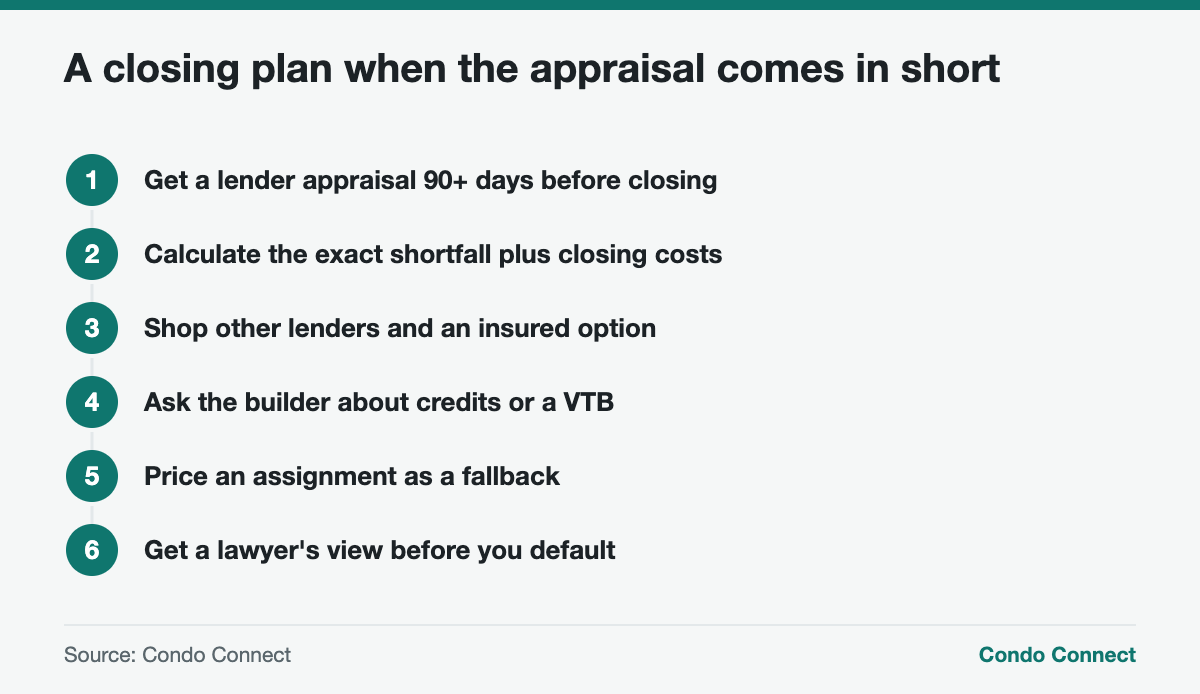
Tip: Order your own appraisal from a lender-approved appraiser four to six months before your expected final closing date, using the latest resale sales in your building and the two or three nearest buildings of the same age. Knowing the number early gives you time to raise money, line up an insured mortgage or start a builder negotiation while it still has leverage.
How to prepare in the 90 days before final closing
- Confirm your closing date range and occupancy status with the builder in writing.
- Get a mortgage commitment based on an actual appraisal, not a pre-approval.
- Have your lawyer draft an estimated statement of adjustments.
- Run the numbers with our mortgage and closing cost calculators.
- Check what comparable units are worth with a condo value estimate if you are considering an assignment.
- Decide on plan A and plan B, and set a date by which you will move to plan B.
Frequently asked questions
What happens if a condo appraisal comes in lower than the purchase price?
The lender bases the loan on the lower appraised value, so you must cover the difference with cash, a larger mortgage product, or a price change from the builder. The contract price does not change automatically. Your land transfer tax is still calculated on the contract price, so the total cash needed at closing rises.
Can I negotiate the price with a condo builder at closing?
You can ask, and in 2026 some builders are agreeing to credits, vendor take-back mortgages or unit swaps because unsold inventory is at a record level. Builders are not obliged to agree. A request backed by a lawyer, an appraisal and a clear explanation of what you can actually close on gets a far more serious hearing.
Will my deposit be refunded if I can’t close?
Generally no. If you fail to close, a typical builder agreement allows the builder to keep the deposit and claim further damages if it resells for less. Tarion’s condo deposit protection, up to $20,000, is aimed at events such as builder insolvency or a terminated project, not at a buyer who cannot complete the purchase.
Can an investor use a 30-year amortization on a pre-construction condo?
The insured 30-year option through CMHC Home Start is for owner-occupied homes, so a pure investor generally cannot use it. Some lenders offer 30-year amortizations on uninsured mortgages with 20% or more down, subject to the stress test. The amortization helps the payment, but it does not fix a low appraisal on its own.
Need a second opinion on your closing?
If your closing is within the next year, start with real numbers. Compare recent sales on our Toronto condo listings, read our pre-construction buying guide, or contact our team to talk through an assignment or a closing plan.
This article is general information as of October 2026, not legal, tax, mortgage or financial advice. Rules and numbers change, so confirm the details for your situation with a licensed professional.