You can sell a Toronto pre-construction condo before final closing by assigning your agreement to a new buyer, as long as your contract allows it and the builder consents. The buyer pays you for your deposit (and any profit), then closes with the builder at your original price. Since May 2022, assignments of new homes are subject to HST, and profits are usually taxed as income, so the real net is lower than the headline number.
Key takeaways
- Check the assignment clause first: some agreements prohibit assignments or only allow them after a set point.
- Builders usually charge an assignment fee, and that fee is generally subject to HST.
- HST applies to the assignment price, excluding a deposit reimbursement that is identified in writing.
- Selling the right to buy within 365 days of signing can trigger the flipping rule: full taxation and no loss claim.
- Assignees of contracts signed before April 2026 cannot use the new enhanced HST rebate, which affects pricing.
How a condo assignment works
When you sign a pre-construction agreement, you are buying a right: the right to purchase a unit at a set price when it is built. An assignment transfers that right to someone else. The new buyer (the assignee) steps into your shoes, and you (the assignor) step out.
The assignee normally pays you two things: a reimbursement of the deposits you have paid the builder, and any agreed premium on top. The assignee then pays the builder the remaining balance at final closing. If the unit is now worth less than your contract price, the assignee will pay you less than your deposit, and you absorb the loss.
Can I assign my pre-construction condo?
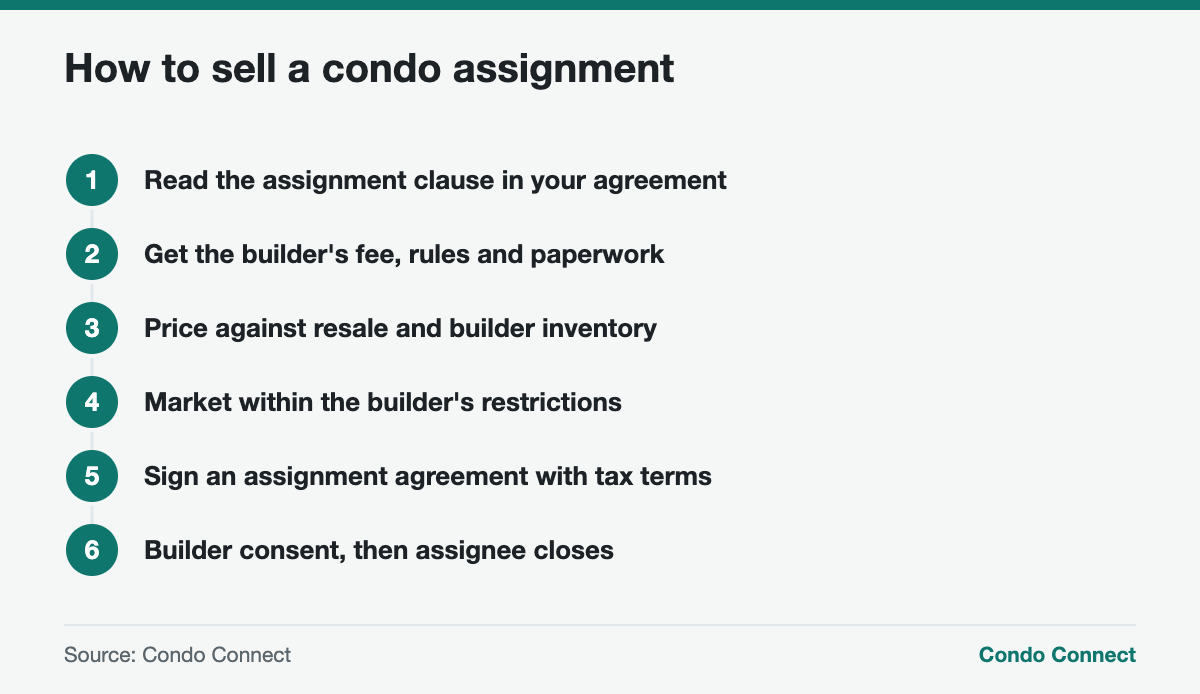
That depends entirely on your agreement. Look for the assignment clause and check:
- Whether assignments are allowed at all, or only with the builder’s written consent.
- Whether you must wait until a certain sales threshold is reached or a certain date passes.
- The builder’s assignment fee and legal costs.
- Restrictions on advertising, including whether you can list publicly on MLS before final closing.
If the agreement prohibits assignments, you may still be able to negotiate one with the builder. In the 2026 market, a builder may prefer a qualified assignee to a defaulting buyer. Our assignment selling page covers the practical steps.
HST on a condo assignment sale
The CRA states that effective May 7, 2022, all assignment sales of newly constructed or substantially renovated residential housing are taxable for GST/HST. Before that, an owner who bought to live in the unit and had a change in circumstances could sometimes sell exempt; that route is effectively gone.
The rule excludes the deposit. Under the measure described in GST/HST Notice 323, the amount attributable to reimbursing the deposit you paid the builder is not taxed, but only if the assignment agreement says so in writing. The assignor is generally responsible for collecting and remitting the tax. Make sure your agreement states the deposit amount clearly and says whether the price is “plus HST.”
A worked example: profit and loss assignments
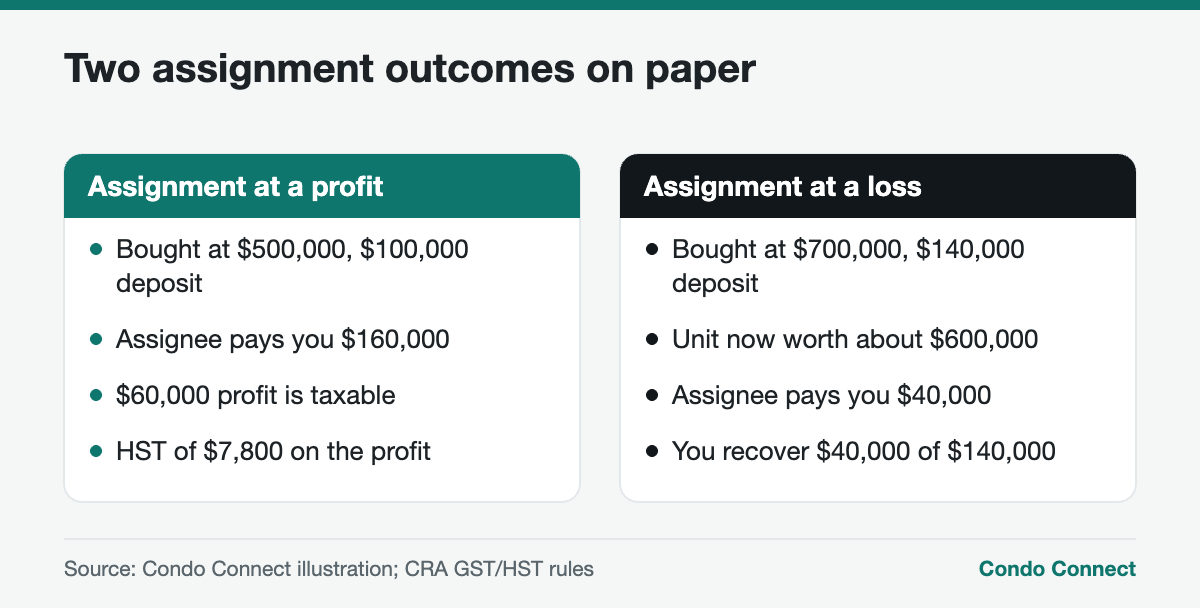
| Item | Profit case | Loss case |
|---|---|---|
| Original contract price | $500,000 | $700,000 |
| Deposits paid by you (20%) | $100,000 | $140,000 |
| Current market value of the unit | $560,000 | $600,000 |
| Assignee pays you | $160,000 | $40,000 |
| Of which deposit reimbursement | $100,000 | $40,000 |
| Taxable for HST | $60,000 | $0 |
| HST at 13% | $7,800 | $0 |
| Your gain or loss before fees | +$60,000 | -$100,000 |
In both cases the assignee then owes the builder the remaining balance: $400,000 in the profit case and $560,000 in the loss case. Builder fees, legal fees and any commission come off your result. In 2026 the loss case is the more common one for units bought near the 2022 peak.
How assignment profits are taxed
Since 2023, the federal residential property flipping rule treats a gain on housing held for less than 365 days as business income, fully taxable, and denies any loss. The CRA’s summary notes the rule applies unless the sale was caused by a life event. Tax firms such as BDO point out that it also covers rights to acquire housing, which includes pre-construction contracts.
Holding longer than 365 days does not guarantee capital gains treatment. If you bought with the intention of reselling, the CRA can still treat the profit as business income. Life events that exempt you from the flipping rule include death, marital breakdown, serious illness, a new family member, eligible work relocation, involuntary job loss and insolvency. A loss on an assignment held longer may be deductible in some cases; that is a question for an accountant.
How the new HST rebate affects assignment pricing
Buyers comparing your assignment with a developer’s unsold inventory will notice one big difference. Under CRA Notice 346, an agreement signed before April 1, 2026 that is later assigned is still treated as a pre-April agreement, so the assignee cannot claim the enhanced rebate of up to $130,000. A completed unsold unit bought today might qualify.
That means your assignment has to be priced below a comparable inventory unit after the rebate, not just below the developer’s sticker price. Our explainer on the Ontario HST rebate on new condos shows the rebate amounts by price.
Tip: Price your assignment from the assignee’s side. Add what they pay you, the balance owed to the builder, the closing adjustments in your agreement and the occupancy fees they will carry, then compare that total with resale units in the same building and the builder’s own inventory. If your total is higher, the assignment will not sell, no matter what you paid.
Assignment vs closing and then selling
If you cannot find an assignee, your alternative is to close and sell as a resale. That means financing the full balance, paying land transfer tax, carrying interim occupancy fees before closing, then paying commission and legal fees again when you sell. A lower appraisal at closing can also leave you short of cash, as our guide to the pre-construction appraisal gap explains. An assignment at a modest loss is often cheaper than closing and reselling at a similar price.
Frequently asked questions
How much does a builder charge for a condo assignment?
It varies by builder and is set out in your agreement or the builder’s assignment policy. Expect a fee for consent, plus the builder’s legal costs, and HST on that fee. The fee is sometimes negotiable, particularly when the builder wants the unit to close. Ask for the full fee schedule in writing before you price the assignment, because it comes straight off your net.
Can I list my condo assignment on MLS?
Only if your agreement allows it. Many builder agreements restrict public advertising of assignments, especially while the builder still has units to sell. Breaching that restriction can put your consent at risk. Agents often market assignments privately or through exclusive networks when MLS is not permitted. Check the clause with your lawyer before marketing.
Do I pay HST on a condo assignment if I lose money?
Usually not, if the agreement clearly identifies the payment as a deposit reimbursement. HST applies to the consideration beyond the deposit amount you paid the builder. In a loss sale the assignee pays you less than your deposit, so there is typically nothing taxable. The builder’s assignment fee is still subject to HST.
Is a condo assignment profit a capital gain?
Sometimes, but often not. A gain on a right held for less than 365 days is business income under the flipping rule unless a life event applies. Even after 365 days, the CRA can treat it as business income if you bought to resell. Keep records of why you bought and why you sold, and get tax advice.
Thinking about assigning your unit?
Get a realistic number first with our condo value estimate, read our assignment selling guide, or contact our team to compare an assignment with closing and reselling.
This article is general information as of October 2026, not legal, tax, mortgage or financial advice. Rules and numbers change, so confirm the details for your situation with a licensed professional.