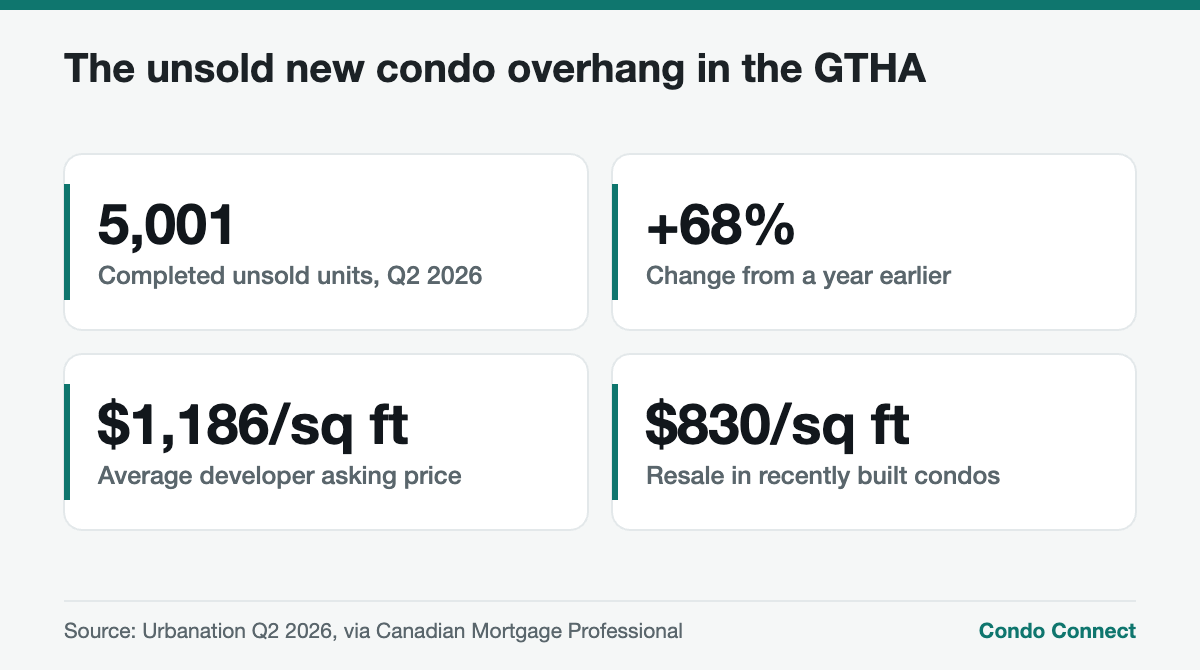
You can buy an unsold, completed condo directly from the developer on a new agreement of purchase and sale, often with a closing in weeks rather than years. In 2026 that can be a good deal: developers are carrying a record 5,001 finished units, and a buyer who will live in the unit and signs before March 31, 2027 may get up to $130,000 in HST relief. The catch is that developer asking prices still sit well above resale, so you need to negotiate from resale evidence.
Key takeaways
- Completed unsold units in the GTHA hit a record 5,001 in Q2 2026, up 68% in a year.
- Developers were asking about $1,186 per square foot versus about $830 for resale in recently built condos.
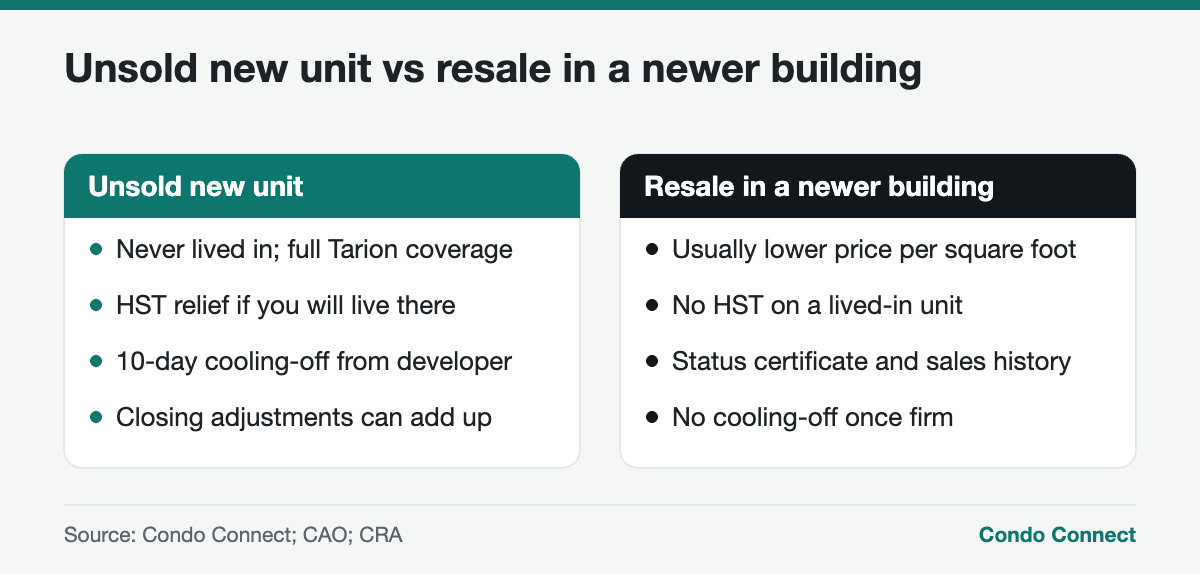
- Buying from the developer generally gives you the 10-day cooling-off period, even for a finished unit.
- A never-occupied unit can qualify for the enhanced HST rebate and for an insured 30-year amortization.
- Negotiate on price, closing credits, parking and fee holidays, and read the new corporation’s first budget closely.
Why so many new condos are sitting unsold
Most of these buildings were sold on paper years ago, but not every unit found a buyer, and some original buyers walked away at closing. Urbanation counted 4,295 completed unsold units in Q1 2026, which was already more than double a year earlier, and 5,001 by Q2. At the slow sales pace early in the year, it estimated the Q1 stock represented about 92 months of supply.
Developers have carrying costs on every unit: financing, condo fees, and property taxes. That is what gives you leverage. It is also why some developers prefer to rent units out rather than cut prices, so not every building will negotiate.
How developer pricing compares with resale
The price gap is the core of the negotiation. Urbanation put the average asking price for standing inventory at about $1,186 per square foot in Q2 2026, against about $830 per square foot for resale in buildings registered in recent years. In Q1 the gap was a record 38%.
On a 600-square-foot one-bedroom, that is the difference between about $711,600 at the developer’s average asking rate and about $498,000 at the resale average. Developer asking prices are usually quoted with HST included, net of the rebates assigned to the builder, so the difference narrows once the new rebate is applied. Urbanation estimated in April 2026 that the enhanced rebate would cut the effective price of unsold new condos by about $100,000 on average and shrink the new-versus-resale gap to roughly 20%.
A 20% premium for a brand-new unit with a fresh warranty can be worth paying. A 38% premium usually is not.
Does the HST rebate apply to a completed condo?
Yes, if you meet the conditions. CRA Notice 346 applies the rebate to condo units bought from a builder where the agreement is signed between April 1, 2026 and March 31, 2027, construction began by December 31, 2028 and the unit is your primary residence or a relation’s. A finished building meets the construction tests already, so the signing date is what matters.
Ask the developer exactly which rebates its price assumes and what you owe if you do not qualify. Our full explainer on the Ontario HST rebate on new condos has worked examples by price.
Do you get a cooling-off period on a finished unit?
When you buy from the developer (the “declarant” in condo law), the developer must give you a disclosure statement and the Condo Guide. According to the Condo Authority of Ontario’s Condominium Buyers’ Guide, the agreement is not binding on you until you receive both, and you have 10 days from the later of receiving the agreement and those documents to cancel for any reason with a full deposit refund. Confirm with your lawyer that the purchase is from the declarant and when your 10 days started.
Resale purchases have no cooling-off period, so this is a genuine advantage of buying new.
What to negotiate with a condo developer
Price is the obvious lever, but developers often prefer to protect their published prices and give value in other ways. Ask about:
- Closing credits applied on the statement of adjustments.
- Caps on closing adjustments such as development charges, utility meter and connection fees, and Tarion enrolment fees.
- Parking or a locker included, or priced well below the developer’s list.
- A maintenance fee holiday for 6 or 12 months, paid by the developer.
- Upgrades or appliance credits, which matter less on a finished unit but can apply to finishes not yet installed.
- A closing date that suits you, including time to sell your current home.
Due diligence on a newly registered building
A completed building has usually been registered as a condominium corporation, which means there is real information to read, not just projections.
- First-year budget and actual spending. Developers sometimes set early fees low. Compare the budget with what the corporation is actually spending.
- Reserve fund study. The first comprehensive study is due within a year of registration. If it is done, ask for the funding plan; big fee increases often follow it.
- Status certificate. Ask for one even when buying from the developer. Our status certificate guide lists what to read first.
- Rental share. A building where the developer is leasing many unsold units can feel more like a rental tower for years.
- Deficiencies. Walk the unit carefully and document every defect before closing. Ask how the developer handles warranty requests and what Tarion coverage period applies to your unit.
Financing a never-occupied unit
A unit that has never been lived in counts as a newly built home for mortgage insurance. Through CMHC Home Start, buyers of new builds can get a 30-year amortization on an insured mortgage, not only first-time buyers. The premium is 0.20 percentage points higher than the 25-year rate.
Lenders appraise against resale comparables, so a contract price well above recent resale sales in the same building can produce a short appraisal. Get the lender’s appraisal before your financing condition expires.
Tip: Before you make an offer, pull the last six months of resale sales and active listings in the same building. If owners on the 20th floor are selling similar units for $150 per square foot less than the developer is asking on the 22nd, you have your opening argument, and the developer’s sales staff will already know those numbers.
Frequently asked questions
Can you negotiate the price of a new condo with a developer?
Yes, especially on completed inventory in 2026. Many developers resist cutting the headline price because it affects appraisals for other buyers, but they will often offer closing credits, capped adjustments, free parking, fee holidays or other incentives. Come with resale evidence from the same building and a clear, financed offer.
Is buying an inventory condo safer than pre-construction?
In several ways. You can see the finished unit and the building, closing happens quickly, and there is no interim occupancy period or construction delay. You still face appraisal risk if you pay well above resale, and new corporations often raise fees after the first reserve fund study.
Do I pay occupancy fees on a completed condo?
Usually not. Interim occupancy fees apply when you move in before the condominium is registered and title can transfer. If the building is already registered, you normally close and take title on the same day. Your lawyer should confirm the registration status before you sign.
Can an investor buy an unsold condo with the HST rebate?
Not the primary residence rebate described here, because the unit must be the buyer’s or a relation’s home. The CRA said guidance on an enhanced rebate for new rental property was expected in October 2026. Investors should get tax advice on the rental rebate before signing.
Looking at new and resale side by side?
Browse Toronto condos for sale, read our pre-construction buying guide, or contact our team for a comparison of developer pricing and recent resale sales in the buildings you are considering.
This article is general information as of October 2026, not legal, tax, mortgage or financial advice. Rules and numbers change, so confirm the details for your situation with a licensed professional.