
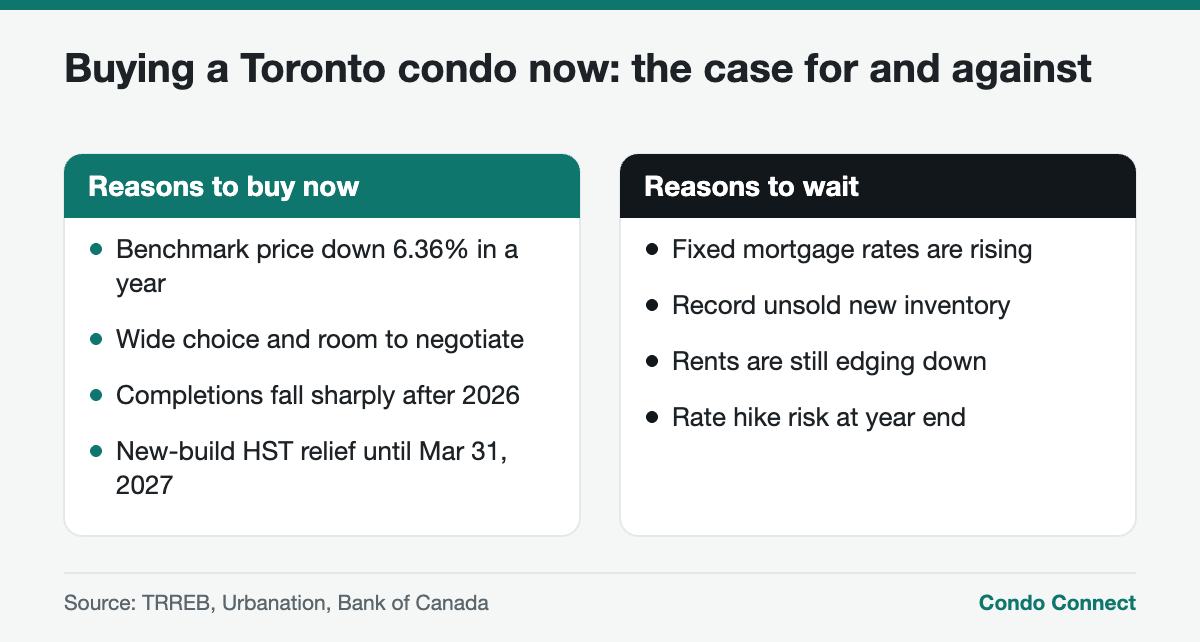
For a buyer who plans to live in the unit for five years or more and has stable income, October 2026 is one of the better windows to buy a Toronto condo in recent memory: prices are down, choice is wide and sellers negotiate. The case for waiting rests on rising fixed mortgage rates and record unsold inventory that could push prices a little lower. Timing the exact bottom is guesswork; buying the right unit at a fair price is not.
Key takeaways
- The City of Toronto condo apartment benchmark was $543,800 in September 2026, down 6.36% year over year.
- Resale condo listings are falling faster than sales, which TRREB says could lay the groundwork for price growth in 2027.
- Developers hold a record 5,001 completed unsold units, which caps prices in the short term.
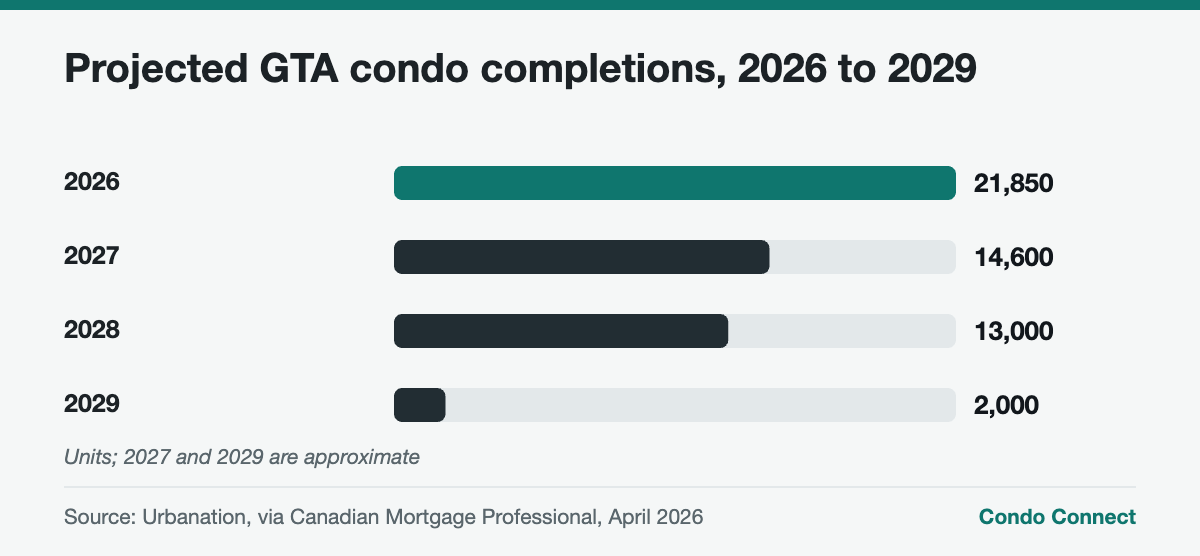
- Projected completions drop from about 21,850 in 2026 to roughly 2,000 in 2029.
- Fixed mortgage rates have risen since September, so get a rate hold before you shop.
Toronto condo prices right now
TRREB’s September 2026 numbers show a market that has corrected, not collapsed. Here are the condo figures that matter, with what each one measures.
| Measure | Value | Change vs a year earlier |
|---|---|---|
| City of Toronto condo apartment benchmark (MLS HPI), Sept 2026 | $543,800 | -6.36% |
| All TRREB areas condo apartment benchmark, Sept 2026 | $527,200 | -6.67% |
| All TRREB areas condo apartment average price, Sept 2026 | $605,257 | -7.7% |
| GTA resale condo sales, Q2 2026 | 4,783 | +8.8% |
| GTA active condo listings, Q2 2026 | 8,061 | -15.4% |
| GTA average condo rent, Q2 2026 | $2,568 | -1.9% |
The benchmark price tracks a typical unit and is the better guide to value. The average price moves with the mix of what sold that month, so treat it as a rough indicator only. You can see the local detail in our Toronto condo market report for October 2026.
Will Toronto condo prices drop further?
Possibly, in the short run. Three pressures are still in place.
- Unsold new inventory. Urbanation counted a record 5,001 completed units still held by developers in Q2 2026, up 68% from a year earlier. Combined new and resale supply equalled 7.3 months of sales.
- Soft rents. Average condo rents in TRREB’s Q2 report were down 1.9% year over year, which keeps investors cautious.
- Borrowing costs. All six big banks raised fixed rates between September and mid-October 2026, and the best discounted 5-year fixed rates sit around 4.3% to 4.6% insured.
Against that, resale supply is tightening. In the TRREB Q2 2026 condo market report, new listings fell 19.0% while sales rose 8.8%. When fewer owners list and more buyers act, prices tend to stabilize first and rise later. TRREB described current conditions as potentially laying the foundation for price growth in 2027.
The supply cliff after 2026
This is the part of the story that gets less attention. New condo sales in the GTHA in 2025 were the lowest since 1991, and there were no new project launches for two straight quarters into mid-2026. More than 11,600 planned units have been cancelled since 2024.
Condo projects often take four years or more from launch to completion, so the shortage of launches shows up later as a shortage of new units. Urbanation projections cited in April 2026 show completions falling from about 21,850 units in 2026 to roughly 14,600 in 2027, 13,000 in 2028 and about 2,000 in 2029.
That does not guarantee higher prices, because population growth and rates matter too. It does mean the oversupply that is weighing on prices today is unlikely to keep growing.
What rising rates and the Bank of Canada mean for timing
The Bank of Canada’s policy rate has been 2.25% since October 2025. The next decisions are on October 28 and December 9, 2026, according to the Bank’s published schedule. In September the Bank said upside risks to inflation had increased, and some analysts see a hike as possible before year end.
Fixed rates follow bond yields, not the policy rate, and the 5-year Government of Canada yield hit a 52-week high in late September. If you are buying in the next few months, a 120-day rate hold protects you from further increases while you shop.
Who should buy now, and who should wait
Buying now makes more sense if
- You will live in the unit for at least five years, so short-term price moves matter less.
- Your income is stable and you pass the stress test with room to spare.
- You want a new unit and can sign before March 31, 2027 to use the Ontario HST rebate on new condos.
- You are paying high rent and have found a unit where ownership costs are close to it.
Waiting makes more sense if
- You may move within two or three years. Buying and selling costs (land transfer tax, legal fees, commission) eat into any gain.
- Your job or income is uncertain. Recent labour data have been weak.
- You are an investor counting on rent to cover costs. With rents easing, many units do not cash-flow at today’s prices and rates.
How to buy well in a soft condo market
- Compare the benchmark for your area with recent sold prices in the specific building, not just asking prices.
- Read the status certificate carefully. A lower price is no bargain if a special assessment is coming; our status certificate guide covers what to look for.
- Check the maintenance fee per square foot against similar buildings nearby.
- Negotiate on more than price: closing date, included parking or locker, appliances and conditions.
- Keep your financing and inspection conditions. Sellers accept them more often in this market.
- Avoid the traps in our list of five costly condo buying mistakes.
Tip: In a building with many investor-owned units, look at how many units are listed for sale and for lease at the same time. If ten similar units are competing for tenants, both the rent you could get and the price you would get on resale are under pressure. A building with few listings and long-term owners usually holds value better in a slow market.
Frequently asked questions
Are Toronto condo prices going down in 2026?
Yes, so far. TRREB’s MLS HPI benchmark for a City of Toronto condo apartment was $543,800 in September 2026, down 6.36% from September 2025. The pace of decline has slowed as resale listings fall, and TRREB has suggested conditions could support price growth in 2027, though that is a forecast, not a promise.
Is it a buyer’s market for condos in Toronto?
For most condo segments, buyers have the upper hand. The overall TRREB market had about 4.6 months of inventory in September 2026, with homes selling at about 98% of list price on average. New and resale condo supply combined was 7.3 months in Q2 2026, according to Urbanation, which gives buyers room to negotiate.
Should I wait for the Bank of Canada decision before buying?
Only if you are choosing a variable rate, which moves with prime. Fixed rates are set by bond markets and have already risen. If you plan to buy soon, get a rate hold now; if rates fall, many lenders will give you the lower rate at funding, and if they rise, you are protected. Ask your lender how its hold works.
What is the benchmark price of a condo in Toronto?
The MLS HPI benchmark for a condo apartment in the City of Toronto was $543,800 in September 2026, according to TRREB. Across all TRREB areas it was $527,200. The benchmark represents a typical unit, so a specific building can be well above or below it depending on location, age and size.
Ready to look at real units?
Browse current Toronto condos for sale, or try Condo Swipe to shortlist buildings quickly before you book viewings.
This article is general information as of October 2026, not legal, tax, mortgage or financial advice. Rules and numbers change, so confirm the details for your situation with a licensed professional.